There’s been a lot going on! Check out all the happenings with results and pictures and mark your calendars for upcoming events!
- Learning to Argue Well in a Complicated World article by Mahayla Bassett
- Food Drive and Jingle and Jive
- Parent Alumni Tournament
- Wall Talk Podcast – Very Merry Monologue Winners
- Robotics – World Festival and Qualifier Competitions
- December and January Speech and Debate Tournaments
- Ethics Plate
- Poetry Out Loud Competition
- Spirit Week
- Civics Day at the Capitol
- Perfectly Yours Valentine Dance
- Looking for Teachers
- Seminar Series: You, Your Kids and AI: Safety and Skills for the New Digital Frontier
- February Online Speech and Debate Tournament
- Healthy School Year
- Save the Date! Preference and Prom
- 2026-2027 Registration
- Alumni Spotlight: Coeby Sorensen
- Fine Distinctions article from our General Director, Sam Martineau
In the Classroom

Mahayla Bassett
Constitution Studies Teacher
Learning to Argue Well in a Complicated World
One of the most rewarding moments in my Moot Court class last semester came when students realized they could argue for a position without believing the opposing side was foolish or malicious. During the semester, our class prepared for a Moot Court competition centered on a constitutional dispute involving religious liberty and equal protection. True to the structure of the program, the class was organized so that students were assigned to opposing teams, each responsible for developing and defending a different interpretation of the law rather than being guided toward a single “right” answer.
As they researched Supreme Court precedents, questioned one another, and refined their oral arguments, students discovered just how layered constitutional questions can be. The same text, history, and case law could reasonably lead thoughtful people to different conclusions. By the time we reached the competition, students were not necessarily trying to “defeat” the other side, but to understand it well enough to respond honestly and persuasively.
In a fitting conclusion, the two teams from my class ended up competing against each other—and each team prevailed on different parts of the case. It was a powerful lesson in how real-world disagreements work. In our complicated world, we need more respectful discourse that challenges ideas instead of attacking people. In Moot Court, students don’t just learn about law; they practice humility, rigor, and respect in a world that is rarely simple.
Recent Happenings
Annual Food Drive and Jingle and Jive

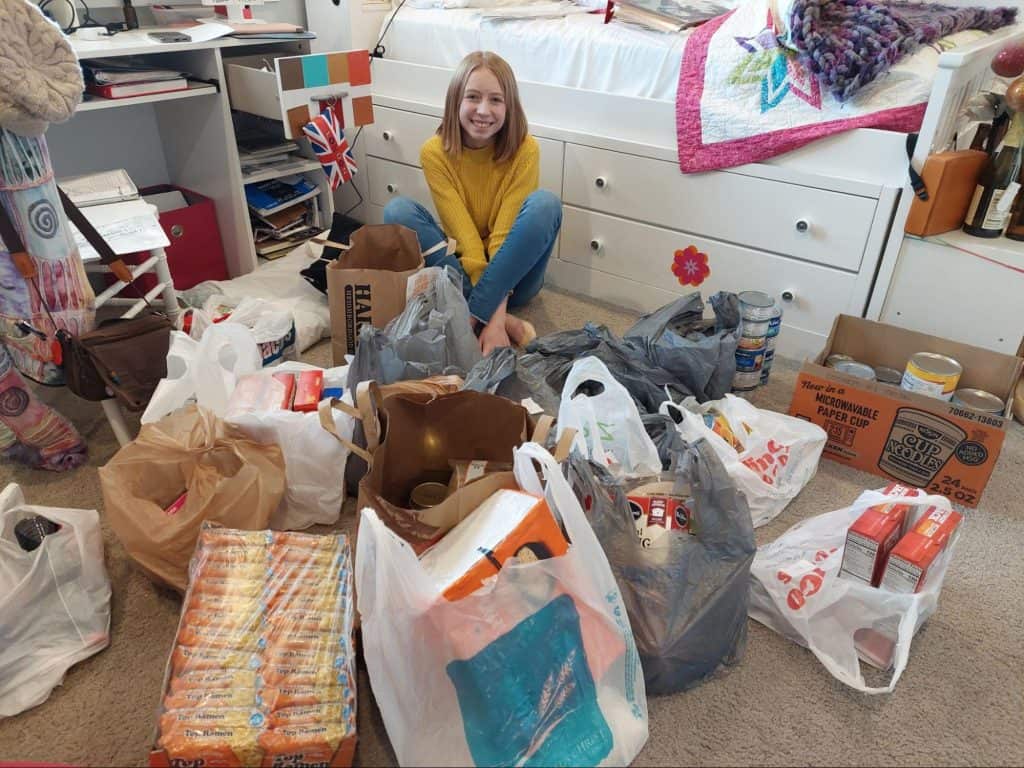

Throughout the month of December, IEProgram students participated in a food drive to gather food and money to benefit their local food banks. Students canvassed their neighborhoods, held hot chocolate stands, and more. Lizzy Madill said, “It was tough, but I loved doing it. It let me actively engage in my community, which is something I value…. I hope it will do as much good as possible.”
The drive was a phenomenal success with a Grand Total of 74,540 pounds of food and money collected by over 100 students in 50+ classes.
Most Pounds Collected by a Student
- Emma McKenzie – 5,692 pounds
- Ollie Swan – 5,390 pounds
- Seth Bennion – 4,375 pounds
Most Pounds Collected by Class
- Woods Cross, Intro to the Constitution – 2,096 lb total, 524 lb/person
- Hyrum, Intro to the Constitution – 2,096 lb total, 524 lb/person
- Provo, Beginning English – 9,054 lb total, 453 lb/person
Beginning Classes (get the highest 3 after overall winners)
- Woods Cross, Beginning English – 3,546 lb total, 322 lb/person
- Provo, Beginning Speech and Debate – 3,750 lb total, 170 lb/person
- Midvale, Beginning Speech and Debate – 1,751 lb total, 97 lb/person
Intermediate Classes
- Riverton, Intermediate Speech and Debate – 8,459.8 lb, 353 lb/person
- Midvale, Intermediate Speech and Debate – 2,051 lb, 228 lb/person
- Provo, Intermediate Speech and Debate – 2,944 lb, 155 lb/person
Advanced/Elite Classes
- Highland, Elite Speech and Debate – 9,423.3 lb, 337 lb/person
- Woods Cross, Constitution and Moot Court – 1,250 lb, 313 lb/person
- Provo, Advanced English – 4,512 lb, 301 lb/person
Jingle & Jive
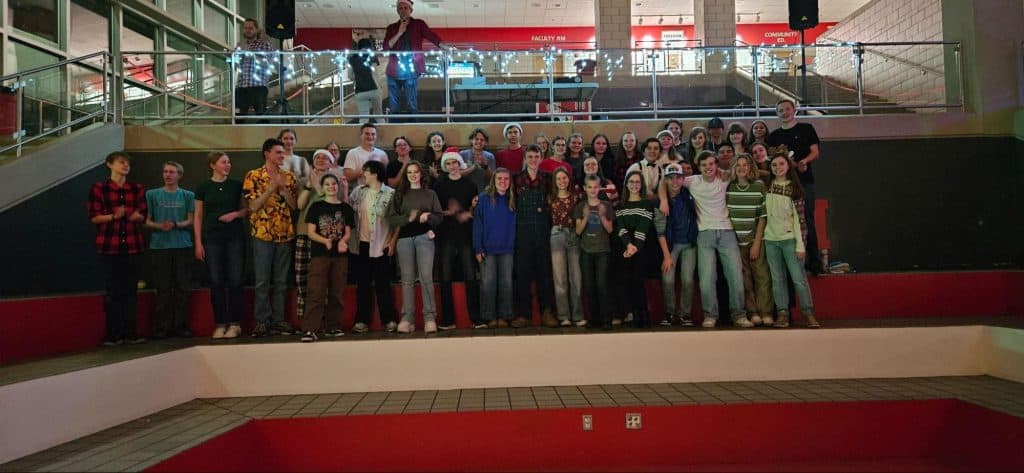
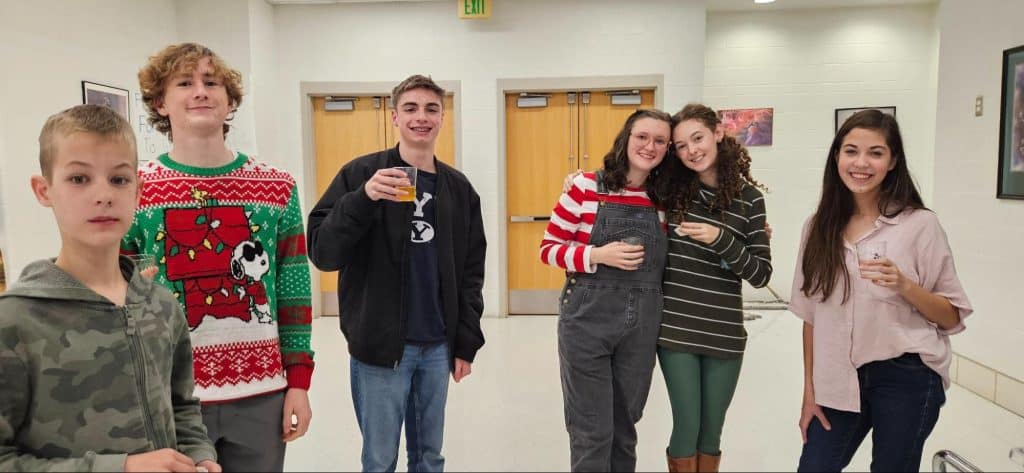
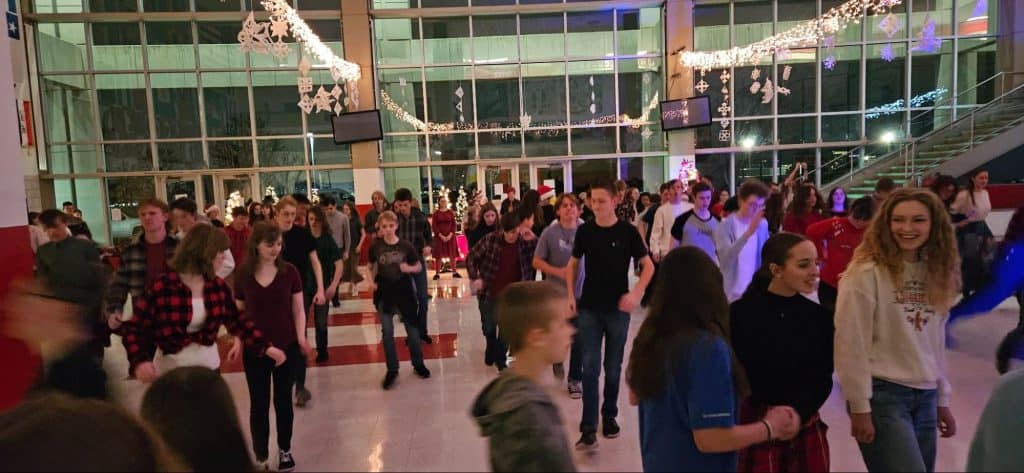
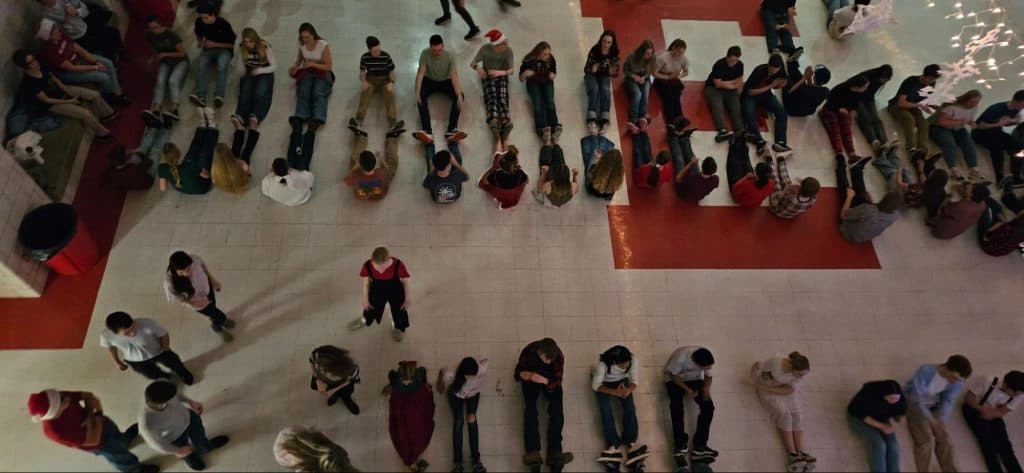
The food drive was celebrated at the 2nd Annual Jingle and Jive Dance on December 19. Special thanks to Marcos Orozco and East High who hosted the dance and helped so much with it! It was a fun night of dancing, games, and checking out Sharpay’s pink locker! Check out the Jingle and Jive Photos here.
Parent Alumni Tournament
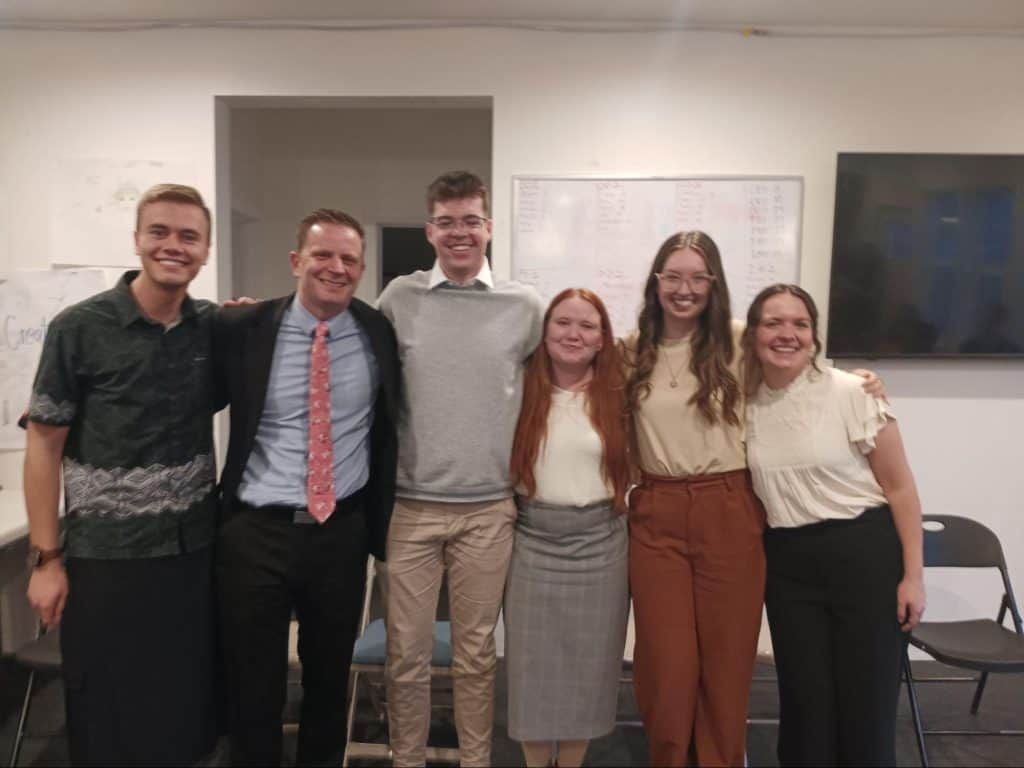
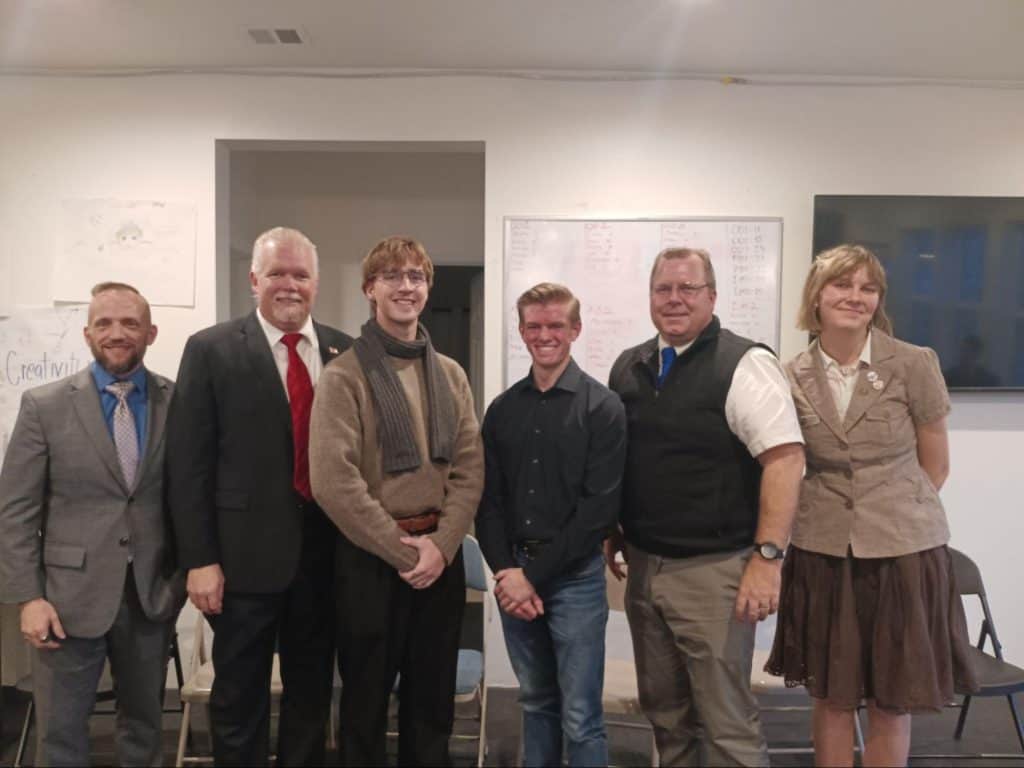
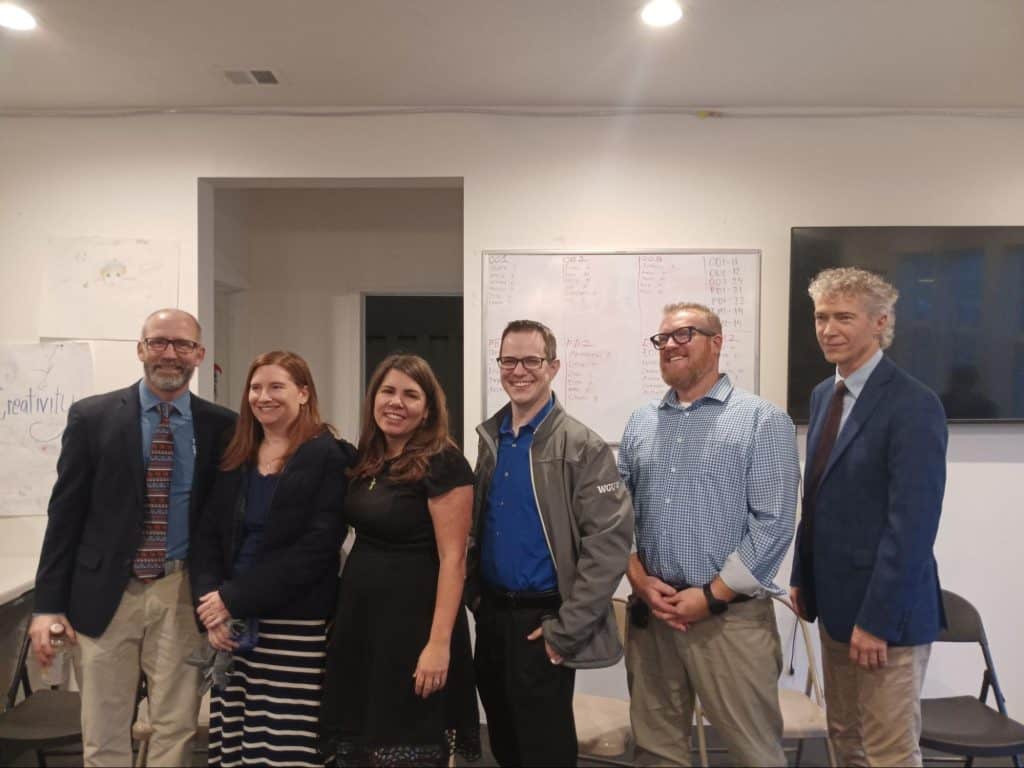
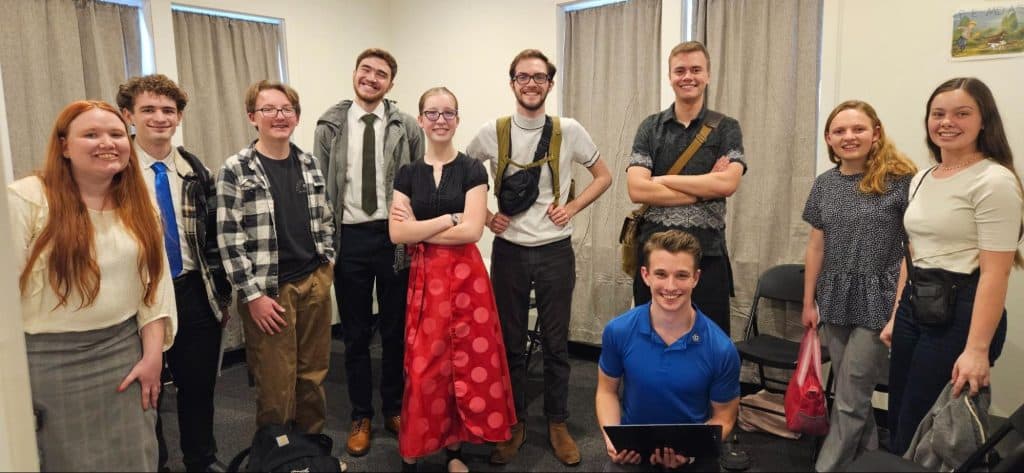
Over 40 parents, alumni, and teachers, and 27 student judges participated in the Parent Alumni tournament and dinner on December 27 in Eagle Mountain. The tournament was a rousing success. Parents who had never competed before and seasoned alumni participated in Oratory, Presidential Debate, and Impromptu events. Congratulations to everyone who stepped out of their comfort zone, grew, and took the time to spend the day together. You can see Parent Alumni Photos here.
The winners in each category were:
Impromptu
- Jared Fenn
- Mickelle Shea
- Eric Hansen
- Brighton Rogers
- Ashley Cook
- Cameron Ward
Oratory
- Zach Young
- Mary Stoddard
- Tess Greene
- Heidi Williams
- Sam Martineau
- Zachary Grant
- Caio Silveira
- Anna Mock
- Jaden Willis
Presidential Debate
- Jeff Whitchurch
- Zakary Shelley
- Ellyn Olenslager
- Lyle Toronto
- Paul Scott
- Simon Brown
Wall Talk – Very Merry Monologue Winners
Wall Talk, the IEProgram student run podcast, held the Very Merry Monologues Christmas Speech Contest in December. The submissions were amazing and helped bring the Christmas spirit to everyone that listened.
Congratulations to everyone who participated. The winning speeches were:
- Daisy McKeon – The Gifts That Never Fit Under the Tree
- Katie Bell – Santa Wore a Brown Overcoat
- Mille Burrows – The Three Pillars of Tradition
- Nathan Childress – The Gift of Receiving
- Hannah Kent – The One We All Forgot
- Ava Morris – Candles of Hope
- Paisley Morris – My Christmas
- Jenna Allan – Creating the Christmas Feeling
- Ammon Garret – Two Fools
- Gordon Hinton – Keep it all the Year
- Eli Jacobsen – The Gift of Presence Over Presents
- Lizzy Madill – Someday at Christmas
You can hear the winning speeches and ongoing episodes on Spotify. Listen to Wall Talk on Spotify here. IEProgram Students can sign up here to Be a Guest on WallTalk.
Robotics
January was a busy month for robotics with lots of competitions and exciting things going on.
Explore Robotics Team X+ (X Plus) Invited to the World Festival in Houston
The Explore Robotics team X+ from Saratoga Springs has been invited to represent Utah at the FIRST Robotics World Festival event in Houston in April this year! They are one of only 40 Explore teams world-wide invited to be part of the event. The festival includes teams from all levels of robotics competition. We’re so excited for them!
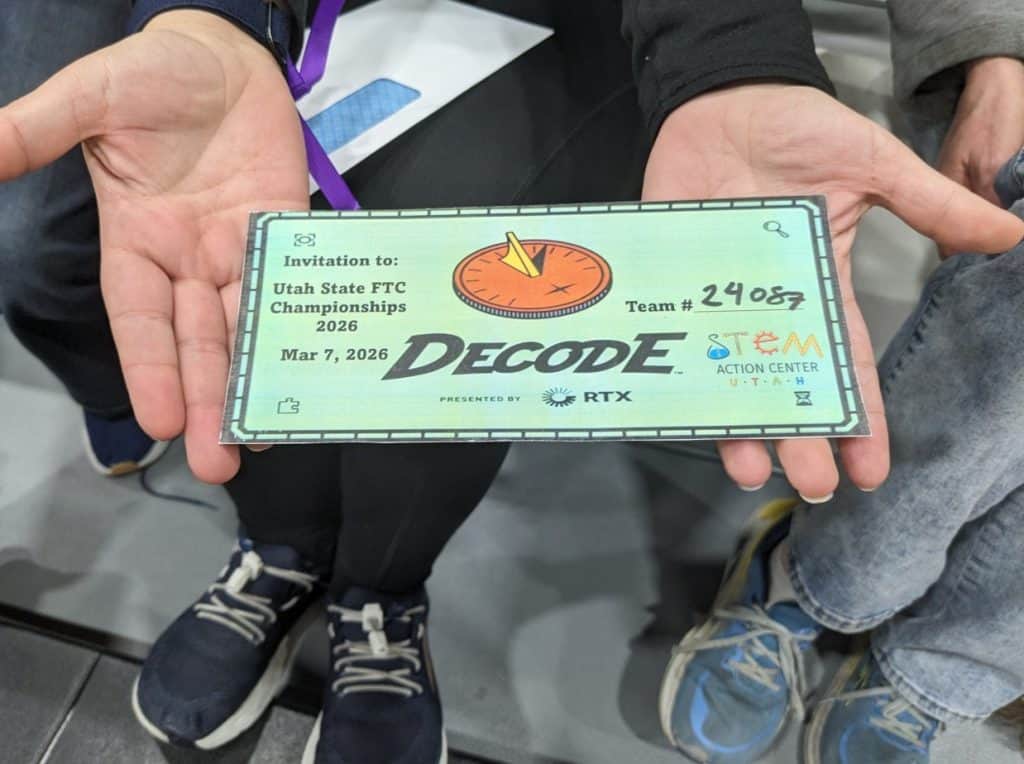
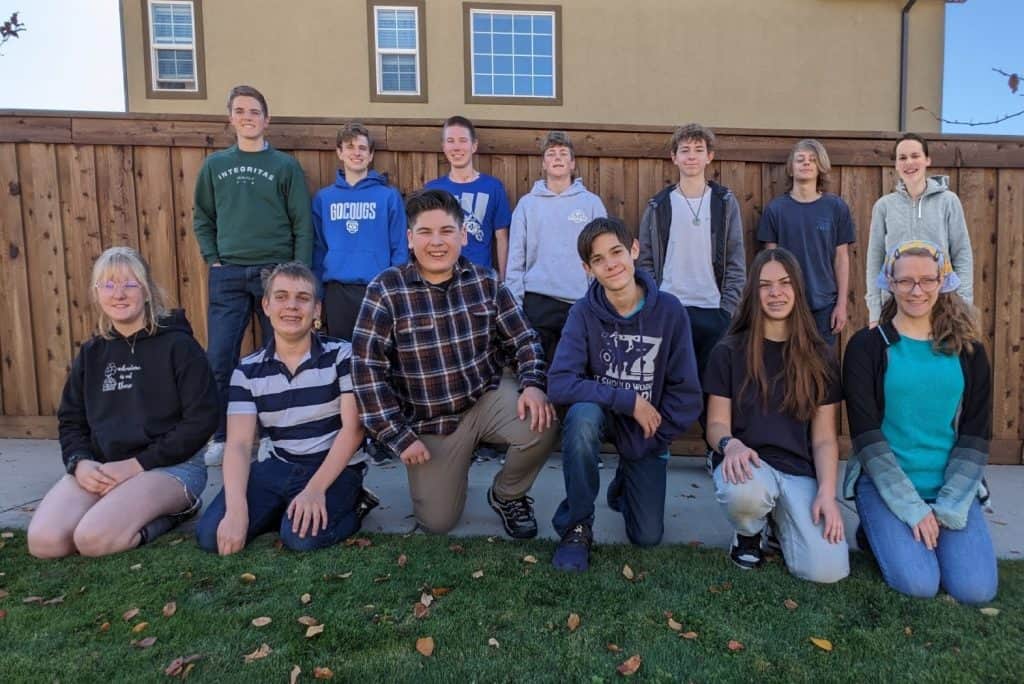
FTC Robotics Team IRS Going to State!
The First Tech Robotics team, IRS, has been working tirelessly to get their robot up and running. They participated in two Qualifier competitions in January – one at Hillcrest High and one they traveled to in Hurricane. They had some exciting rounds where they did all the things including using their robot to throw balls into the target autonomously and with a driver. Their best round was the high score for the day up to that point and included a clean game with no fouls and both sides getting around 100 points (that’s a lot!). They also had some tense moments when it looked like they’d have to tear their robot apart to fix an issue, but luckily they found another solution by consulting with another team.
When it was all said and done, Team IRS won the Sustain Award and received a ticket for the Utah State Competition in March! Great Job to the team and coaches – Skylar Hess, Rachael Gunsay, Brycen Williams, Daniel Hansen, Samuel Hansen, Caleb Eichelberger, Jase Mitchell, Bethany Broderick, Aliyah Graden, Matthew Gierisch, Roman Olson, Lincoln Martineau, Ryu Bott and coaches NiCole Hale and Brittny Hansen!
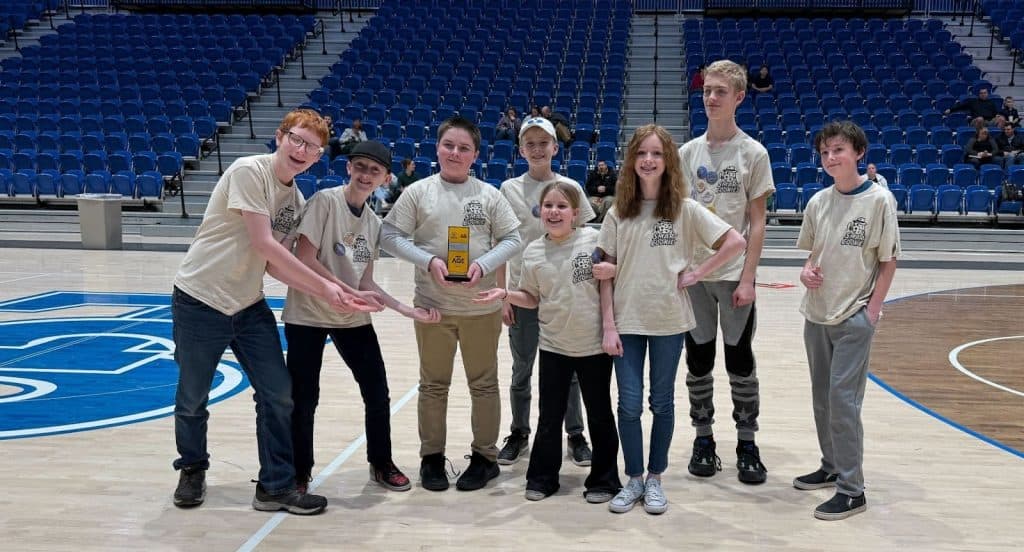
Robotics Challenge Teams Competitions and Awards
The Challenge robotics teams each had competitions in January. Challenge teams compete in 3 areas – with their robot, with an innovative project they design, and in core values including gracious professionalism and coopertition. Each team worked all year and battled setbacks and sickness to prepare for their competitions. Congratulations and great work to:
- The French Fry Diggers from Woods Cross competed at Weber State and got a score of 175 with their robot and really great feedback on their project. Congratulations to Richard Smith, Maya Graden, Quinn Earl, Hyrum Parkinson, Ryan Reynolds, Mikey Shea, and Jefferson Miller with coach Melissa Earl.
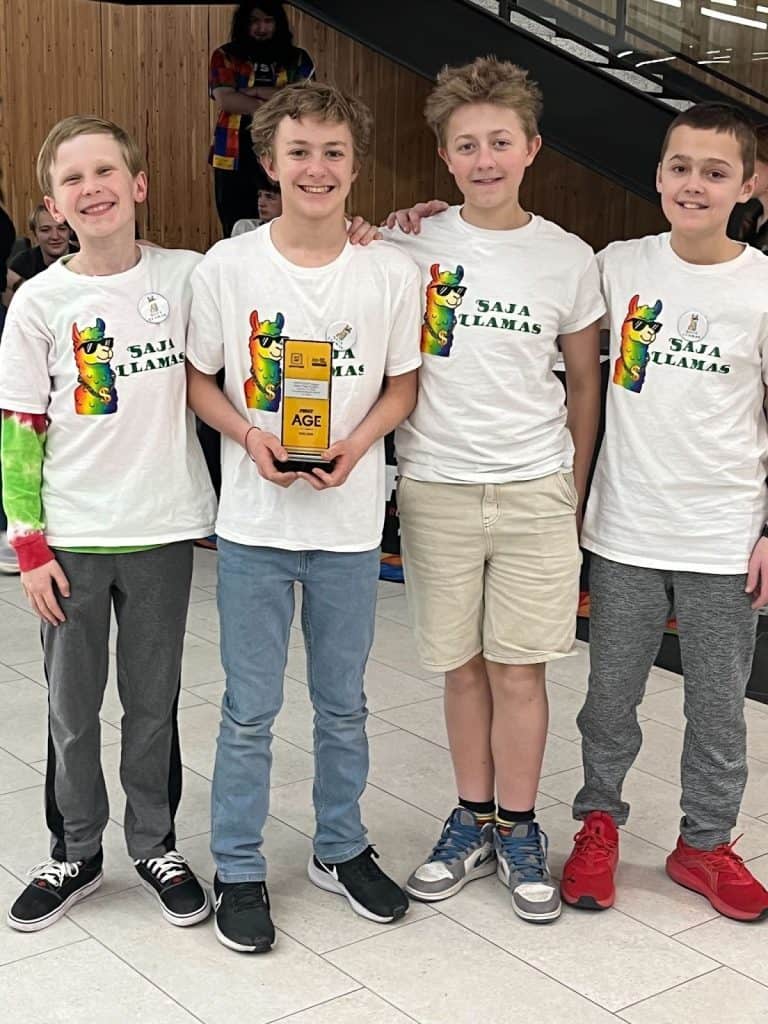
- The Saja Llamas from Woods Cross competed at Weber State and finished with 190 points with their robot and won the Innovation Award! Congratulations to Sammy Martineau, Jeremiah Parkinson, William Smith, Eli Ferguson, Seth Miller, Brock Zesiger – with coach Melissa Earl.
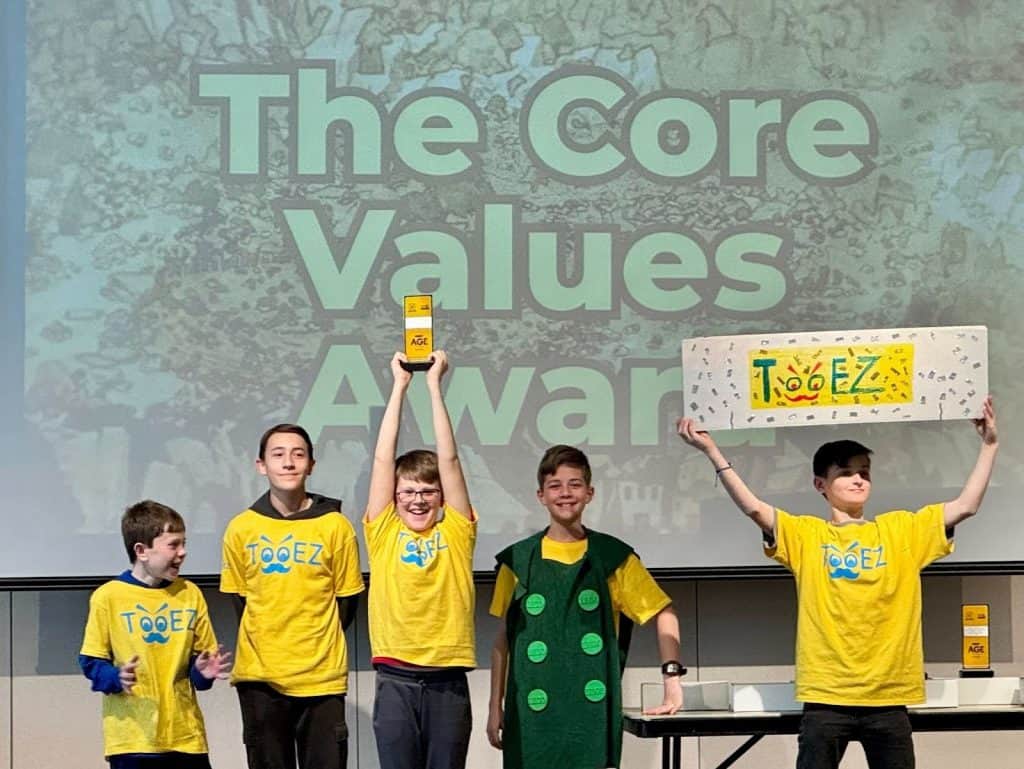
- The Tooez from Mapleton competed at the Provo Rec Center and won the Core Value Award! Amazing job to Chase Cazier, Henry Van Wagoner, Sawyer Van Wagoner, Darius Tang, Aiden Smith, Carter Christiansen, Benjamin Sproul and their coaches Danielle and Andy Huff.
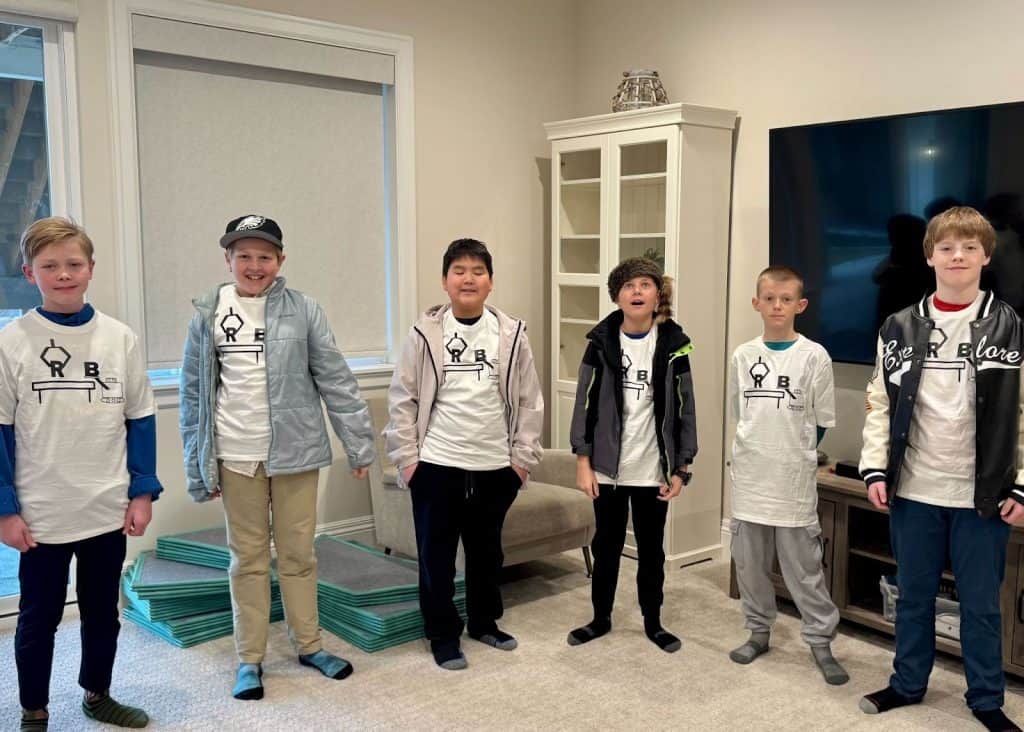
- The RBs from Mapleton competed at the Provo Rec Center and won the “Stronger than Stone” Award for their resilience! Great work to Asher Riffle, Kai Riffle, William Lloyd, Jesse Jones, Emmett Lloyd, Carter Hays, Truman Osmond, Maxwell Hammon, Otto Lee, Joseph Wirrick, Gabe Rowley – and coaches Danielle and Andy Huff and Zach Grant.
- The Smart Cookies from Saratoga Springs competed at SLCC and won 1st Place in the Innovation Project. Way to Go Abigail Desmond, Brandon Miner, Landon Krueger, Luke Olmo, Lucas Boissonnault, Daxton Wade, Gabriel Broderick, Remington Cottam, Jax Hiatt, Maeli Hansen and coach Adrianne Thygerson.
The Smart Cookies project was creating the Cool Circuit System – a wearable solution designed to help archaeologists stay cool and keep their devices powered while working outdoors. It is a hat made of flexible, washable solar fabric that sends energy to a built-in power bank inside a neck fan. This system provides lasting cooling and portable power, even during long days in the sun.
December Paradigm Beginning Tournament and January Paradigm Tournament
Paradigm High School was amazing and hosted the December Beginning Speech and Debate Tournament and the January Speech and Debate Tournament! Thank you to Taylor Dalton and the rest of the Paradigm leadership and staff for helping make those tournaments happen. The beginning tournament had over 100 competitors and the January tournament had 317 competitors with 65 judges! Congratulations to all of the competitors and thank you to the judges! You can see Tournament Pictures Here and Results Here.
Ethics Plate (an Ethics Bowl Competition)
The IEProgram hosted the Ethics Plate for multiple high schools on December 18 at Timpanogos High School in Orem. Students participated in ethical discussions on topics ranging from HOA fees to organ donors. There were 18 teams that competed. Congratulations to all who competed. The top teams were:
- Du hast bereits verloren: Caleb Liddle, Heber Tanner, Adam Tanner, Claire Huntsman, Grace Huntsman
- The Justice League: Michael Jones, Carson Brown, Keely Rogers, Clara Darley
- The Trolley Operators: Melanie Smithson, Bella Young, Nathan Childress, Betsy Shea, Matthew Jordan
- The Utility Bill: Malachi Nielson, Teancum Whitchurch, Aurora Davidson,Peter Preston, Chloe Woellhaf
- Stoic the Vast: Shawn Walker, Seth Bennion, Landon Tanner, Melody Saunders, Ammon Garrett, Lizzie Cutler
- ArisTOTLE-ly Awesome: Mitchell Shepherd, Elizabeth Madill, Olivia Madill, Seth Richens, Vidalia Armstrong
Poetry Out Loud Competition
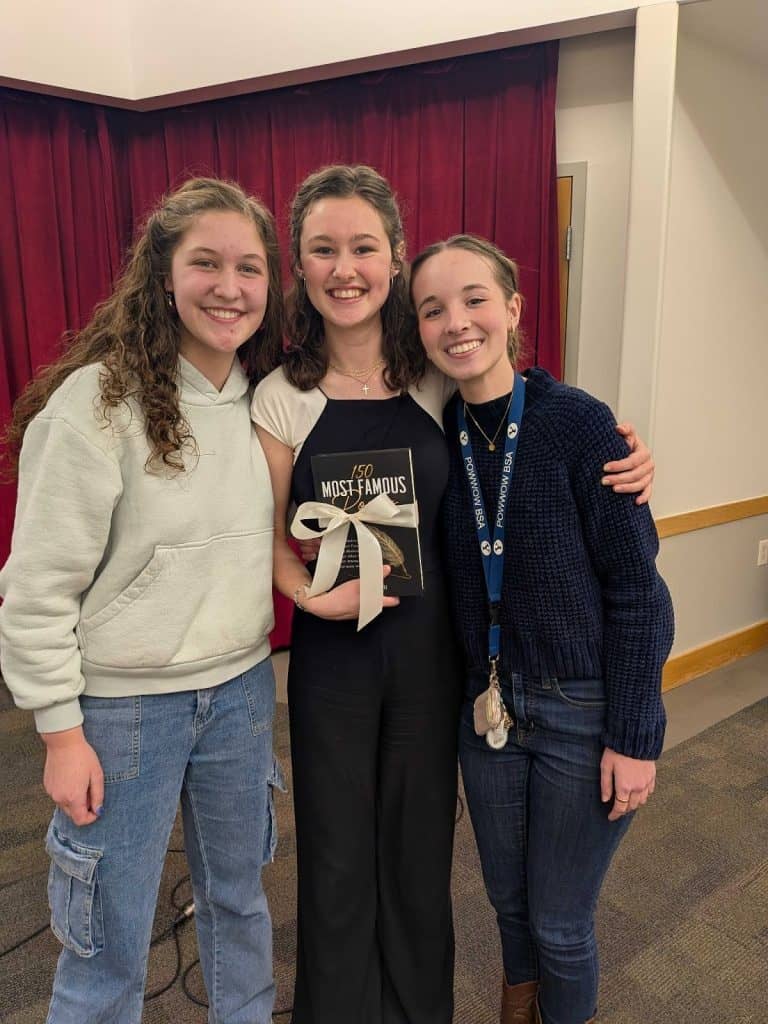
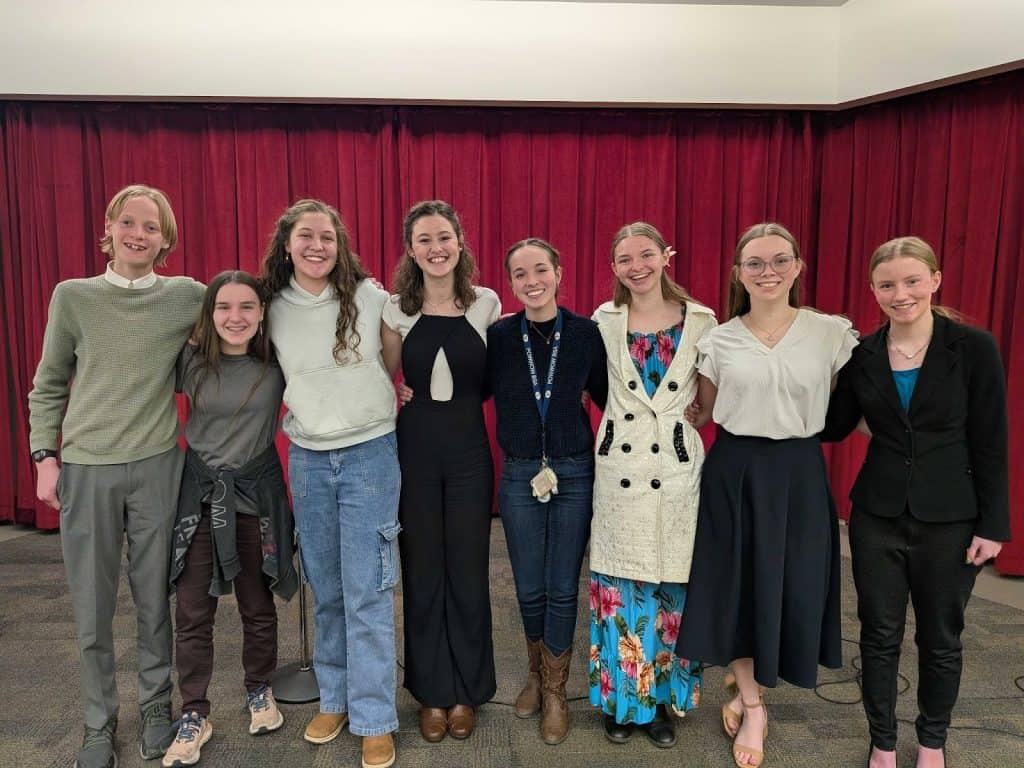
In January, the English Department held a qualifier poetry competition to send students to the Poetry Out Loud competition in poetry recitation. Congratulations to the winners!
- 1st Place – Katie Bell
- 2nd Place – Sophia Shields
- 3rd Place – Adelia Swan
Katie Bell will go on to represent the IEProgram at the regional competition in February.
Spirit Week Results
The Student Council headed up a Spirit Week January 12-15. There were different themes for each day – Anything but a Backpack Day, Dynamic Duos, Career Day, Favorite Team Day, and Decade Day. There was a lot of fun spirit including a whole set of Wizard of Oz characters, Mario and Luigi and a bunch of favorite teams. Here are the Spirit Week 2026 Photos Thanks to everyone that participated. The winning classes are:
- Monday: Layton Elite Speech and Debate
- Tuesday: Provo Elite Speech and Debate
- Wednesday: Highland Elite/Highland Beginning Speech and Debate
- Thursday: Riverton Elite Speech and Debate
- Friday: None
Overall Winner: Provo Elite Speech and Debate!
Civics Day at the Capitol
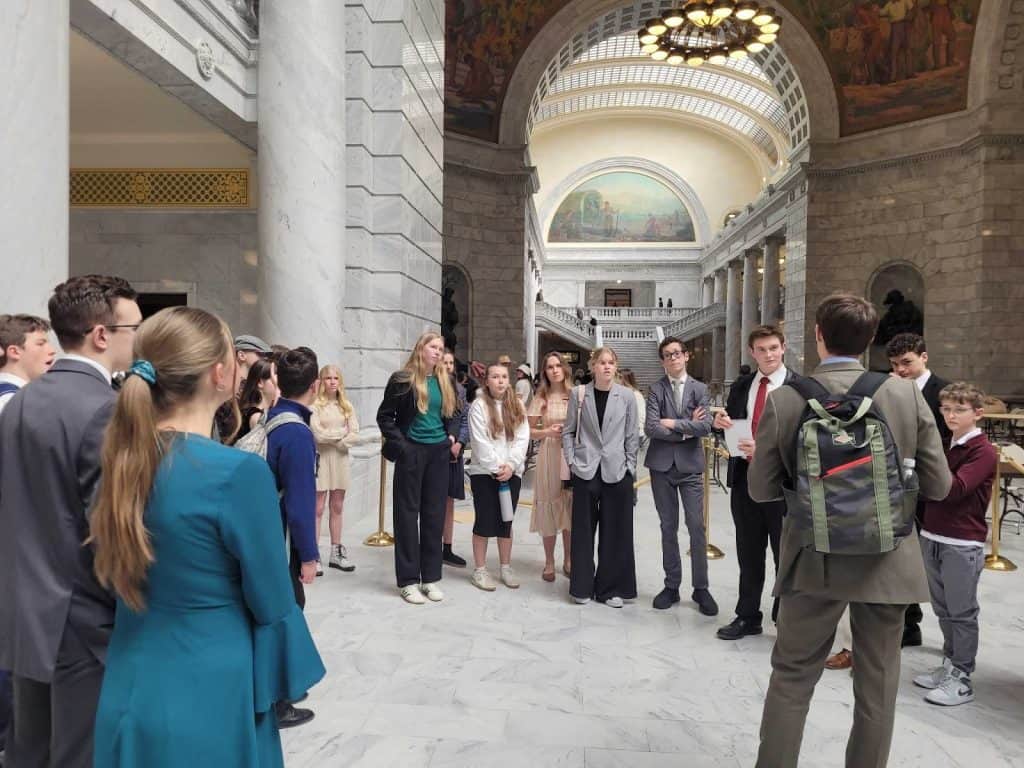
Students participated in the annual Civics Day field trip on February 4, organized by the Constitution Studies program. The trip included a behind-the-scenes tour of the Utah State Capitol, private meetings with state legislators, and time observing floor debates and committee meetings of the state legislature. The students even got a chance to explore the floor of the Utah House of Representatives! A huge thank you to the IEProgram teachers Mary Stoddard, Mahayla Bassett, NaLyn Nelson, Zach Young and the public servants and staff on Capitol Hill who made this incredible experience possible for our students!
Perfectly Yours Valentine Dance
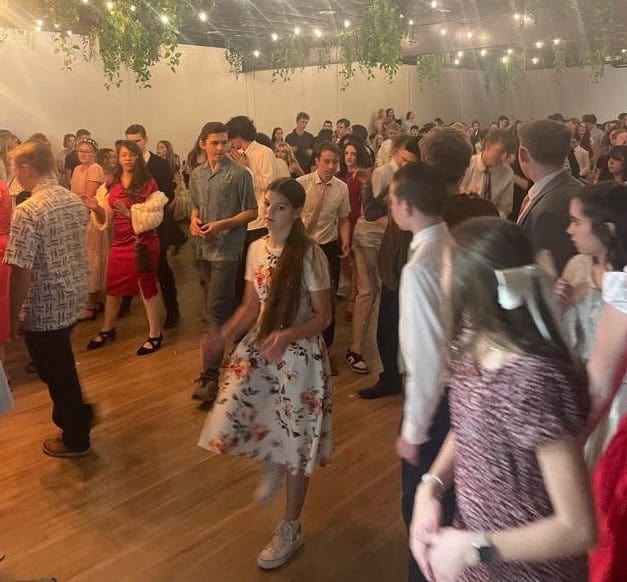
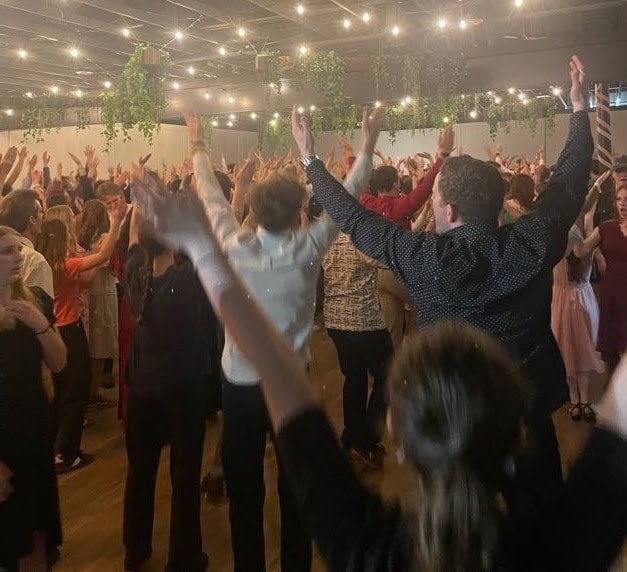
Over 200 students participated in the second annual IEProgram Valentine Dance, “Perfectly Yours,” on Friday, February 6. It was a fun night of snowball dance, speed dance, line dance, swing dance, and slow dance. Check it out here: Valentine Dance Photos
Many thanks to Shawn Walker, Aaron Tingey, Lincoln Early, Eliza Hepworth, Melanie Smithson, Sophia Shields, Kathy Kydd, Ivana Gleason and Megan Sigrest, Jantzen Russell and Sam Martineau for their help putting on the dance. Thank you too to the parents who volunteered to help make it possible.

Looking for Teachers
It’s time to start planning for the 2026-2027 school year. We’re looking for teachers to teach next year in the IEProgram. If you’re interested in applying, apply here 2026-2027 Teacher Application.
We are especially looking for the teachers for the following:
- Robotics
- Pre-algebra in Davis County and Salt Lake County
- English in southern Utah County
Coming Up
Seminar Series
This year, the IEProgram is hosting a series of adult seminars for parents on a variety of topics. Coming up soon is You, Your Kids, and AI: Safety and Skills for the New Digital Frontier presented by ToriAnn Perkey.
If your kids aren’t already using AI (they probably are), they will be soon.
We have entered the next frontier of Artificial Intelligence, and you need to know enough to keep your kids safe and teach them how to use it in alignment with your family values.
In this presentation, ToriAnn will be giving a practical, realistic overview of AI that acknowledges this new reality without being alarmist or overly optimistic.
You, Your Kids, and AI: Safety & Skills for the New Digital Frontier
In this presentation, you’ll learn:
- What this new level of AI is (and isn’t) – and the latest advancements you should be aware of
- How to use AI so it enhances learning rather than eliminating it
- Safeguards you can put in place to keep your children safe
- How AI is changing the higher-education landscape (for better and worse) and how you can prepare your kids
- How AI can assist you in your homeschool and your life (its applications are much broader than you may think)
Presentation Date & Time:
- Date – Thursday, February 26
- Time – 6:30pm – 8:30pm
- Location – Holladay, UT (exact address provided after you register)
NOTE: This presentation will be geared to adults, but teens are welcome to attend if they are interested.
Register here: https://forms.gle/rgGX7UVfGteifJjx7
This presentation is FREE — but we need you to register so we can get a count of who is coming. A recording of the presentation will also be made available afterwards. Please register if you would like to receive the recording.
February Online Speech and Debate Tournament
The February tournament is all online and is scheduled for Saturday, February 21. Since it is all online, anyone – students, parents, alumni – can participate and judge from anywhere! We always need judges!
We have a new system for judges to register and turn in ballots. It is beautiful! Great work to Jared Johnson who has been building and refining it over the past several tournaments. Come check it out!
Register to Judge the February Online Tournament Here
Healthy School Year
Healthy School Year continues! Recent activities have included game nights and movie nights. Activities are free and any teens are welcome to join. You don’t have to be an IEProgram student to participate, but you do need to register for Healthy School Year activities.
Current Healthy School Year Activities
- Game Nights with Nalyn Nelson in Hyrum/Logan every 4th Friday of the Month. Sign Up for Game Nights
- Winter Hike on Friday, February 13 to Waterfall Canyon. Meet at the trailhead at 1pm. Sign Up for Winter Hike
Preference and Prom
Save the date for two more dances this school year!
- Preference will be Saturday, March 21 at the Provo Library Ballroom.
- Prom will be Saturday, April 18 at Castle Park in Lindon. Watch for more information.
2026-2027 Enrollment and Registration
It’s almost time to start thinking about the 2026-2027 school year. There will be two parts to registering for classes this year – Enrolling in the IEProgram and then registering for classes. Enrollment will begin in April and must be completed before class registration.
- May 5 – Priority Registration for classes opens at 6am. Priority registration is for current families who have fulfilled their volunteer requirement. Enrollment must be completed before you can register for classes.
- May 7 – General Registration for classes opens at 6am. This registration is open to anyone enrolled for the 2026-2027 school year.
Alumni Spotlight: Coeby Sorensen
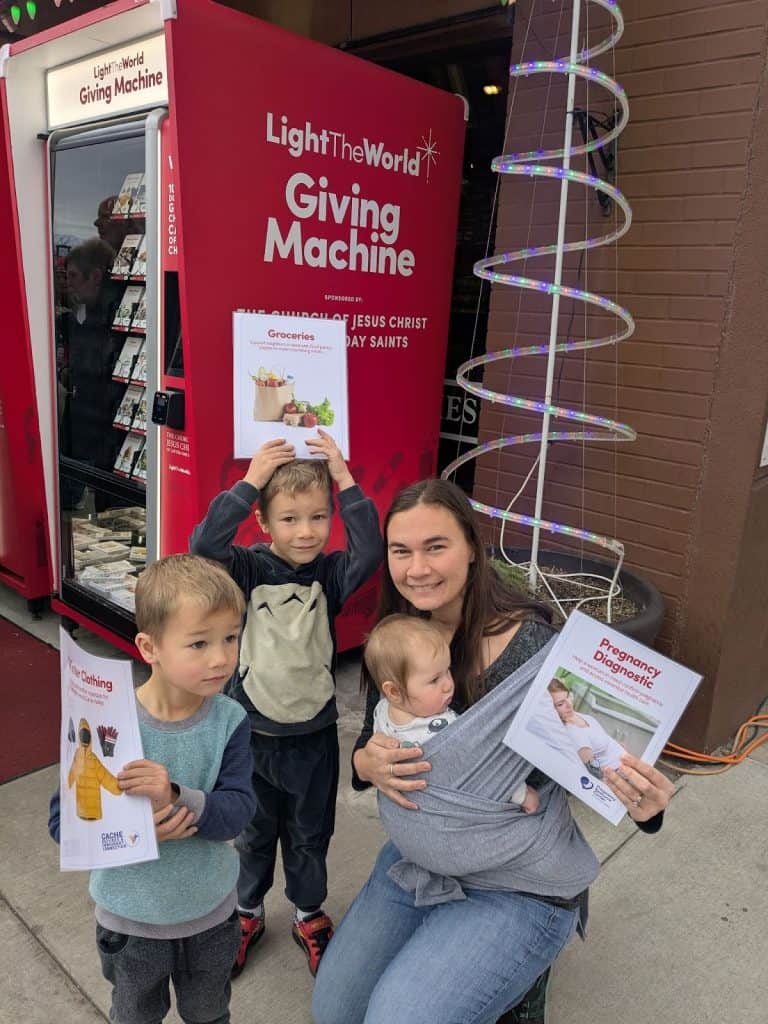
Taking debate helped me to have a stronger desire to lead a life that influences my community for good. I have since graduated from USU with a double major in community health and communication studies. I learned how to efficiently organize programs in the community, as well as how to effectively communicate in many situations. One of the highlights of my college experience was getting to be a teacher’s assistant for the public speaking class. I loved helping others find their voice.
I now am a stay at home mom with 3 kids 4 and under. I’m looking forward to starting to homeschool my oldest in the fall. I enjoy spending my days outside and in the kitchen and love coming up with recipes to post on my blog wholesomeandhappy.com.
Alumni! We’d love to spotlight you! We want to know what you’re doing, celebrate your accomplishments, or hear how IEProgram classes have helped you as you’ve moved forward in life! Please let us know what you are doing here: Alumni Corner Submissions We’ll share your contributions in future newsletters.
Insights in Education: Fine Distinctions
By Sam Martineau
General Director
“How is a kid this smart missing something so simple?” It’s a question I asked several years ago, and I have to admit that this student had me fooled. Which is what this article is about. Sometimes kids can fool you if you aren’t thinking about intelligence in fine detail.
I was wrapping up a unit for older students about research and online information. We talked about how to think critically about sources of information that they might encounter online. I showed students many different online sources as examples. Some were very respectable publications. Others were inflammatory and irresponsible. Others were in between. I did my best to keep those opinions to myself, though, and just asked students to talk me through what they were seeing. They did a good job picking up on things. We talked about whether or not publications had a clear distinction between editorials and news, whether they tended to use click-baity or loaded language, how sources chose to frame arguments, whether they offered sources as support for claims that needed support, whether opposing voices were given the right to reply, and so forth.
Along the way we had extensive conversations about bias in sources and bias in ourselves. I explained that all people have their own biases which means that reliable sources aren’t bias-free, but rather that you can see that they take measures to mitigate bias, or at least to let you know where their biases lie. And, just as importantly, as consumers of information we are biased as well, so how we perceive the bias of a given source will be influenced by our own pre-existing beliefs. Specifically, people are likely to see sources that confirm their beliefs as less biased and sources that contradict their beliefs as more biased. And, of course, I explained that the statement would be true for me also so how I talked to them about sources was influenced by my own biases.
To conclude, we did an interesting activity. I went through a variety of sources and had students rate where they thought the sources stood on a scale reliability in telling both an accurate and complete story as well as where they thought the biases of the sources lay. It was interesting to see students’ ratings, but among all my classes one student fell far outside the norm. Where others gave different sources a variety of ratings, he rated every source as perfectly unreliable.
It puzzled me because I considered this student one of the most intelligent and capable in a very intelligent and capable class. I was certain that he hadn’t misunderstood the nature of the activity or the concepts of the lesson. So I asked him about it after class. He said that he was a biased observer, and therefore unable to fairly rate the reliability or biases of any source. It was at this point that I felt baffled. “How is a kid this smart missing something so simple?” Like I said, he had me fooled. Actually, maybe it was more accurate to say that I had me fooled.
The reason I had me fooled was because I wasn’t thinking through intelligence with any sort of fine distinction. I thought, “He can organize his thoughts, his comprehension is high, he can structure his arguments well, he’s very good at formal logic, and he is articulate. He’s a logical thinker, so how is he missing such a simple idea?”
I wonder if you have ever thought something similar? Did you ever look at a student and because they were strong at organizing ideas, understanding information, analyzing, structuring arguments and were logical thinkers you thought to yourself, “Job done! They are critical thinkers!” Well you were probably right that they really were critical thinkers in that way. But I would also suggest that the question is worth a second look, because if you aren’t looking at intelligence in fine distinction you may miss a key lesson that this particular experience taught me:
What we traditionally call logical thought is a separate mental skill from nuanced thought.
A study published in 2023 in the scientific journal Experimental Psychology and Cognitive Science makes the point well. In the study researchers wanted to understand whether or not deductive reasoning and probabilistic reasoning can truly be considered distinct mental skills. They tested the question by using brain imaging to see if participants using different types of reasoning would draw on separate neurological resources as they thought through logical questions. The design of the study was both simple and interesting.
Participants in the study were asked to evaluate logical operations of three types. All three types were valid, meaning that the conclusions could definitely be drawn if the premises were assumed to be true. But they differed in the level of how likely they were to be true in real terms. Some had a high probability of being true in real terms because there were very few intervening factors that might contradict the major premise of the logical operation. For example:
- If the person jumps into the swimming pool, then the person gets wet.
- The person jumps into the swimming pool.
- Therefore, the person gets wet.
As you can see, very few factors would make it false that if you jump in a swimming pool that you wouldn’t get wet. Maybe if you were wearing a space suit, but otherwise it’s pretty close to a guarantee.
Other logical operations had a low probability of being true in real terms because of a large number of possible intervening factors in the major premise.
- If the person sits in the draft, then the person catches a cold.
- The person sits in the draft.
- Therefore, the person catches a cold.
In this case you can see that if you sit in a draft, you might wear a sweater, have a strong immune system, not be exposed to a virus, etc. and any of these might keep you from catching a cold.
Finally, some of the logical operations had no basis for probability or improbability. For example:
- If the box is empty, then the box has stars on it.
- The box is empty.
- Therefore, the box has stars on it.
As you can see, there is no particular reason to believe or disbelieve the major premise because whether or not boxes with stars are empty is entirely contextual.
For all three types, participants were also asked to evaluate invalid operations (invalid meaning that the premises don’t necessarily add up to the conclusion) such as:
- If the person jumps into the swimming pool, the person gets wet.
- The person gets wet.
- Therefore, the person jumps into the swimming pool.
As participants evaluated the logical operations, half were asked to evaluate the validity of the conclusion based on formal rules of logic. This means that they were instructed to presume that the premises were true and to simply evaluate, yes or no, whether the conclusion followed logically from the premises.
The other half of participants were asked to reason in probabilistic terms. This means that they were instructed to consider on a scale how likely the conclusion was to be true given their understanding of the real world and how it works. By comparison, one of these tasks was very simple and the other more complex. The results were fascinating.
fMRI imaging showed that as the participants considered the questions, the two groups drew on very different areas of the brain to do the two different types of thinking. However, this was only true for two of the three types of operations. For both the high and low probability operations, participants in the two groups drew from different areas on different sides of the brain. However, with the operations that had no basis for probabilistic reasoning, participants reverted to the parts of the brain used for formal logic.
These results suggest that not only are probabilistic reasoning and deductive reasoning distinct mental skills, but that the distinction is grounded in biology and brain structure. This, in turn, suggests that a person may have well developed pathways to facilitate one type of thinking, but poorly developed pathways to facilitate another.
As a side note, there is more to the study and it is relatively readable and very interesting, so if you want to take a further look, you can see it here.
Which brings me back to my poor assumption and lack of fine distinction regarding my student’s poor assumption and lack of fine distinction (the irony here is deep).
Bias isn’t a binary issue. People don’t just simply have bias or not. Everyone has bias in some degree large or small depending on a host of contextual factors. And bias doesn’t either entirely erase the ability to draw his conclusions or not interfere at all. It always interferes to some extent based, again, on many contextual factors. So bias isn’t best understood as a simple yes or no issue. It’s more like a scale. The question is how much bias affects our judgment in a given situation. It’s a difficult question that you probably can’t answer perfectly, but that doesn’t mean you can’t come to any meaningful conclusions. But that isn’t how my student was thinking about it. My student was treating bias as a simple yes or no issue. I have bias, therefore I am entirely biased. He wasn’t seeing in fine distinction, but neither was I. I assumed that just because he was so strong in what we traditionally call logical thought that seeing bias as a complex issue of scale instead of as a binary issue would be clear and intuitive for him.
Since that experience with my very intelligent student years ago, I’ve come to appreciate the distinction I was missing more and more as I’ve come to see both what we traditionally call “logical thought” and what I am calling here “nuanced thought” as key issues in a student’s intellectual development and ability to capture a good and meaningful life. I’ve also observed that the activities and frameworks we pursue in education often emphasize traditional logical thought but leave something to be desired in the realm of teaching nuanced thought.
To help you understand the stakes here, let me offer a profile of what I have come to recognize as students who are very capable logical thinkers, but have room to grow as nuanced thinkers. These students are well organized, articulate, have high comprehension, are often regarded as thought leaders, and speak with lots of confidence. These students tend to really believe in their conclusions deeply. Of course they do! They have thought through them, their opinions can be logically concluded from the premises they operate on. And they can organize and explain what they think.
But on the other hand, these students also don’t exhibit a great ability to wonder if they are incorrect. They aren’t sorting through probabilities and counter examples of their premises in the way that they might. This means that they sometimes fail to consider contradictory evidence or arguments to their own premises even if those contrary arguments and evidence are readily available and fairly obvious. As a result, they are often baffled, exasperated, or even angry that others haven’t drawn their same conclusions. These students also tend to speak and think in sweeping absolute terms and dichotomies such as “celebrities are just idiots,” “we all know that politicians are corrupt,” “capitalism is oppression,” “feminism ruins everything it touches,” “American history is an embarrassment,” “good parents raise good kids,” or, of course, the absolute inverse of any of these statements. This effect means that these students are often susceptible to strawman fallacies and tend to evaluate statements as either absolutely true or false, even if those statements would be better understood as “mostly,” “sometimes,” or “contextually” true or false. So statements like “people are biased” or “crimes are bad” tend to register in their minds more like “all people are absolutely biased” or “all crimes are absolutely wrong to the same degree.”
Have you ever met students like this? Have you ever, more generally, met people like this? Maybe the most important question of all: have you ever been people like this? If you have, maybe you can appreciate why I think it matters to treat and teach nuanced thought as a distinct skill. Perhaps you can project out with me: how strong a person is in nuanced thought can have a huge impact on how they can get along with others, take feedback, develop the sort of mature frameworks that help navigate the really complex parts of life, and critically examine their own biases.
So, to that point, I would like to contribute some frameworks for those who would like to think about, teach, or develop nuanced thought in finer detail. Specifically, I would like to point out mental skills that make major contributions to nuanced thought.
Mental Skill #1: Perceiving Fine Distinction
A number of studies, including this one, have established that musicians are much better at distinguishing between minor pitch changes in notes than non-musicians. In other words it is at least reasonably fair to say that, on average, trained musicians actually hear more notes than people without training. This is a pretty good metaphor for nuanced thought and noticing fine distinction.
I’ll use an example to explain. I used to frequently say to students that “success is best defined as a process as opposed to an outcome.” What that means seemed clear enough to me, but I came to realize that students weren’t always hearing the note that I thought I was playing. Was it because they were dummies? No, it’s just that minds that are maturing (or even mature minds) don’t always see in fine distinction.
I had a student come back after graduation once and ask, “Sam, I’ve been thinking about this a lot. If success is a process, not an outcome, what if you have to escape a bear? Would you be happy that you just tried really hard to escape the bear?” It was a humorous way to make a serious point. Don’t outcomes matter? But here is the question. Did you catch the fine distinction between what I said and what he asked? He asked “If success is a process, not an outcome….” But that isn’t precisely what I said. I told him that I was going to repeat what I had always told him and that I wanted him to really pay attention to its meaning. “Success is best defined as a process as opposed to an outcome.” He got a big smile and said he couldn’t believe he had missed it all those years.
Essentially his maturing mind was finally able to distinguish between the notes
- Success is always a process and never an outcome
and
- On the whole, when seeking to define success in its most meaningful aspects, it is better to think of success as a process than an outcome.
The ability to see to that level of fine distinction has to be hard won, but it enables high level comprehension, reduces misunderstandings, and increases the ability to really say what you are trying to say.
Mental Skill #2: Perceiving Ambiguity
Perhaps this mental skill is just a different shade of mental skill number one (in fact maybe they all are), but is still worth a mention. Do a little exercise with me. Imagine that you read a book and a character in the book makes the statement about the church they grew up in, “I hated that church.” To some that statement will seem very straightforward. The character is anti-that church. Clear enough. But to others the statement may seem to have a great many more possible meanings. So what does it look like to you? What possible meanings do you see? And do those possible meanings come naturally, or did you have to think pretty hard about it? For example, did it strike you that the character may have meant
“I hated that doctrine.”
“I hated that congregation.”
“I hated being in that church, but would have loved being in another.”
“I hated the experience of being in church.”
“I hated the church building.”
“I hated the preacher at church.”
“I hated that my parents made me go to church.”
“I hated the whole church experience for reasons I didn’t understand, but now I do.”
“I hated the whole church experience for reasons I didn’t understand and still don’t.”
“I hated that church, but ‘hated’ is purposefully past tense because I no longer hate that church.”
We could go on for a while here.
As I watch students converse, I sometimes see them take as absolutely certain what is actually only a possible interpretation of another student’s statement. And that doesn’t usually matter too much in class because as they continue to discuss the misunderstanding is usually cleared up. But what about circumstances in which that isn’t possible? What about scam-adjacent advertisements that use purposeful ambiguity for profit? What about personal or political statements that could produce very different meanings depending on how they are understood. The ability to perceive ambiguity allows us to think and speak with greater precision, avoid being taken advantage of, and leave room to consider what someone means as opposed to making quick judgments.
Mental Skill #3: Avoiding Out-Group Homogeneity Bias
A study from 1980 offers interesting insight into a type of bias all of us have observed and participated in called out-group homogeneity bias. In the study students from two rival universities were asked to observe decisions made either by students from their own or the rival school. They were then asked how likely it was that others from the same university would make the same choice. The result was that participants were significantly more likely to predict that students from the rival university would make the same choice than students from their own university. It’s just one example of a well-studied phenomenon: people tend to see members of an out-group as more homogenous (similar to each other) than members of their own group. What I thought particularly interesting about the study is that the choices observed were relatively neutral such as choosing one type of music over another. One might expect to observe out-group homogeneity bias if the observed choices included things like shoving over a helpless grandma (of course “they” all do that, but “we” wouldn’t all be like that). But apparently the effect stayed true even if there wasn’t an intellectual motivation to lump the out-group together.
This sort of bias, and the ability to work against it has big implications for how cohesive society can be. Have you ever heard someone talk about “Trump supporters,” “the Jews,” “the gays,” “homeschoolers,” “public schoolers,” “liberals,” or “conservatives” as monoliths? Like what is really going on is some sort of hive mind where “they” work in concert to accomplish “their” agenda or just generally be dumb unlike “our” group? If you have, then maybe you can see the implications that I’m talking about.
This sort of thinking allows people to take their least favorite members of a given group and use them to represent the motivations and actions of the entire group. It allows us to make the sort of dismissive sweeping generalizations about other groups of people and divide the world into simple categories of good guys and bad guys in a way that causes a lot of problems in American discourse.
And this type of thinking is also inaccurate. People in any group do have enough in common to be in the group, but human hive minds don’t exist and every group of humans is full of humans that aren’t a different species than our own. As much as our own groups are made up of differing motivations, levels of commitments, and thought processes, others are too. And mature nuanced thinking is good at perceiving that fact.
Mental Skill #4: Perceiving False Binaries
One of my most exciting moments as a teacher is when I see a student grow enough in nuanced thinking to challenge false binaries. A false binary is a mental construct that forces one to choose between two options when there is no reason that other options couldn’t be taken. For example, legislators here in Utah are considering lowering the licensed driving age. It’s well established that teens get in more wrecks than older drivers, so key to the debate is the question of why that is true. Do teens get in more crashes because their brains are still developing or because they are inexperienced?
So did you catch it? The phrasing of my question presents a false binary. It presumes that the answer is going to wholly be one of these two options. But there is no reason that both couldn’t be contributing factors in any possible combination of how much they each affect the issue. And, of course, there isn’t any particular reason that there couldn’t be other factors involved as well.
So, like I said, when students start to challenge false binaries, it’s a big moment for me. But there is actually a moment that I like even better. This moment isn’t when they start to challenge other people’s false binaries, but when they start to challenge their own. Because, you see, my long experience teaching debate has taught me that people can be very motivated to engage in nuanced thinking if it helps confirm what they are motivated to believe. But it is much more difficult to engage in nuanced thinking that challenges what we currently believe. So when students begin to challenge false binaries, or think in fine distinction, or perceive ambiguity, or challenge their out-group homogeneity bias in ways that challenge rather than support confirmation bias, it becomes clear that nuanced thinking is really blossoming and becoming intuitive.
Conclusion
We might add other mental skills to the list of contributors to nuanced thinking including accurately imagining the perspective of another person, challenging one’s own biases, skill in calculating probabilities, or others that I don’t have the skill or experience to describe. But short of exploring every possible avenue, I hope that the discussion has been helpful. Specifically I hope you’ll have better frameworks for understanding than I did when I was left asking, “How is a kid this smart missing something so simple?” There was a good answer to that question, and with that answer, perhaps I could have helped him grow in ways I did not. Going back and giving it a second shot would be my first preference. But time doesn’t work that way (trust me, like Kip I’ve looked into it for myself) so my second preference is to understand better in the future.