
It’s hard to believe we’re almost halfway through the school year. We’ve seen amazing learning, working, and growing. We’re excited for all the things our students are doing and all the opportunities still ahead. We wish you a wonderful holiday season!
Here is what you’ll find in this newsletter:
- Becoming a Community article by Bekah Preston
- December Paradigm Beginning Speech and Debate Tournament
- Ethics Plate
- Wall Talk Podcast – Christmas Edition
- Food Drive and Jingle and Jive
- Parent Alumni Tournament
- Healthy School Year
- Robotics Showcase
- November Speech and Debate Tournament
- 1st Amendment Speech Contest
- Adult Seminars
- Robotics Fundraising and Sponsorship
- Alumni Spotlight: Anabel Jackson
- Looking for Teachers
- Fake Choices article from our General Director, Sam Martineau
In the Classroom

Bekah Preston
Robotics Teacher
Becoming a Community
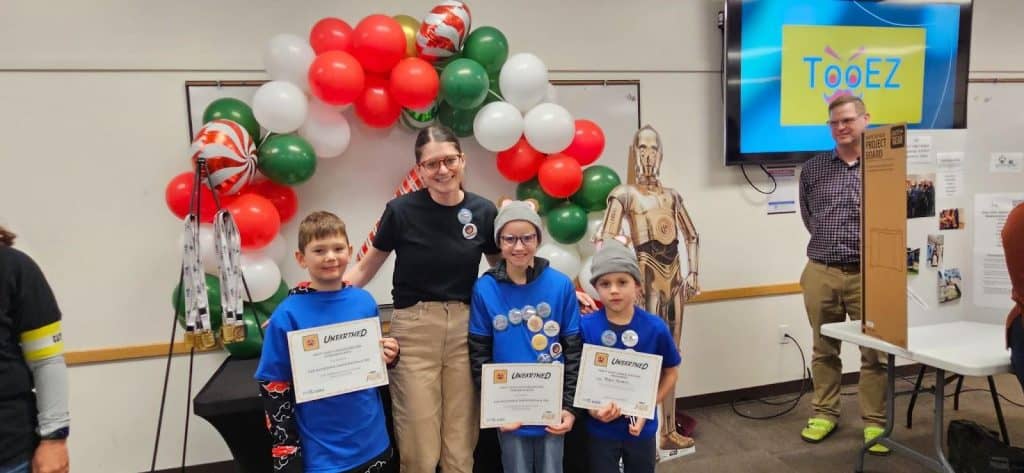
What do you get when you take a group of kids, a pile of plastic bricks, and a laptop? You get lots of LEGO airplanes, little songs and dances about chickens and bananas, and plenty of wiggle breaks to play Hit the Deck. But you also build the confidence needed to share ideas, foster communication and listening, and learn to problem-solve as a group. These concepts are simple, but their execution requires a lot of practice. I’ve participated in both wonderful and nightmare group projects before, and what their success has most often come down to is communication. Though it can be difficult to work together in a group—especially in a creative setting—as we learned to communicate this semester, a team became a community.
Coming Up
December Paradigm Beginning Speech and Debate Tournament

The December tournament is this Saturday, December 13 at Paradigm High in West Jordan and will be a Beginner’s Tournament only. Parents and alumni are welcome to come judge. Sign up to judge here.
Ethics Plate (an Ethics Bowl Competition)

The IEProgram is hosting the Ethics Plate for multiple schools on Thursday, December 18 from 3:00-9:00 at Timpanogos High School in Orem.
The Ethics Plate is open for Intermediate and Elite Speech and Debate students and students in other High Schools. Teams of 3-5 students compete in.
Information, Rules, and Cases can be found here: https://ieprogram.org/ethics-bowl/
We are looking for judges who are strong critical thinkers and, above all, need to be able to ask good questions that critically examine an argument. If this is you, we’d love to have you judge! Judging fulfills the volunteer requirement for parents.
Register to Judge Ethics Bowl Here. Registration closes Thursday, December 11.
Wall Talk – Christmas Edition

Wall Talk, the IEProgram student run podcast, is hosting Wall Talk’s Very Merry Monologues Christmas Speech Contest! Listen to Wall Talk in the days leading up to Christmas for the winning speeches. Listen to Wall Talk on Spotify here. IEProgram Students can sign up here to Be a Guest on WallTalk.
Annual Food Drive

The Annual IEProgram Food Drive is in progress. IEProgram students all over Utah are running food drives and gathering money for their local food banks! Thank you for supporting them in any way you can. Reach out to any current student to make a donation. You can also donate directly to the Utah Food Bank here: Donate to the Utah Food Bank here.
Jingle & Jive

Students will celebrate the Food Drive effort with the second annual Jingle and Jive for students ages 12+. Students will get in free if they gather the equivalent of 100 pounds of food or money. Any student 12-18 (does not need to be an IEProgram student) can attend the Jingle and Jive with a $20 donation to the Utah Food Bank at the door. Dress is informal Christmas (Santa hats, Christmas sweaters, etc.)
Parent Alumni Tournament – Saturday, December 27
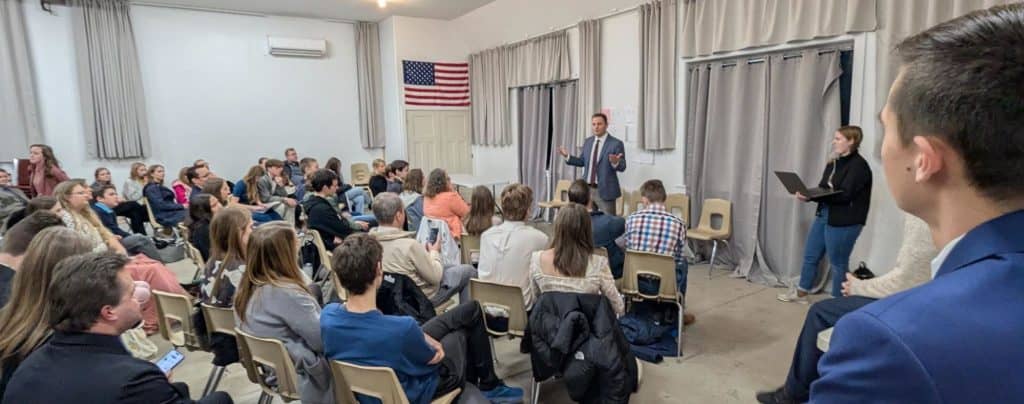
All parents and alumni are invited to participate in the Parent Alumni Tournament on Friday, December 27 in Eagle Mountain. The tournament is a great continuing education opportunity and also a great way to connect or reconnect with a quality group of people. The events this year are Oratory, Presidential Debate, and Impromptu. Impromptu is for parents only. There will also be a dinner afterward.
Date: December 27, 2025 – Tournament 12:00-5:00, Dinner 5:30-7:30
NEW Location: 9383 N. Canyon Wash Dr. Eagle Mountain
Who can compete: Any Adult
Tournament Registration: $10, Dinner: $15
Will you be judged: Yes, you will get ballots on your performance
Register as a Participant in the Parent Alumni Tournament Here
Elite Students and students with a parent participating in the tournament, Register to Judge Here.
Healthy School Year

Healthy School Year is off to a great start. Recently students have participated as volunteer victims in a first aid training, watched and discussed films, played games, and worked out at local parks. Weekly workouts finish up this week and will resume in March. Activities are free and any teens are welcome to join. You don’t have to be an IEProgram student to participate, but you do need to register for the Healthy School Year activities. Invite anyone that might be interested!
Current Healthy School Year Activities
It’s a Wonderful Life movie Tuesday, December 16 from 7:00-10:00 in Woods Cross
Mafia Game Night Friday, December 26 from 7:00-9:30 in Roy
Recent Happenings
Robotics Showcase
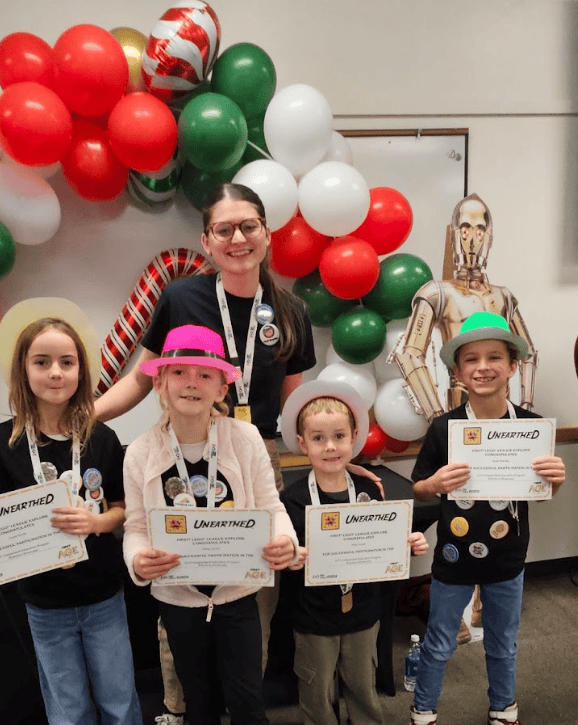
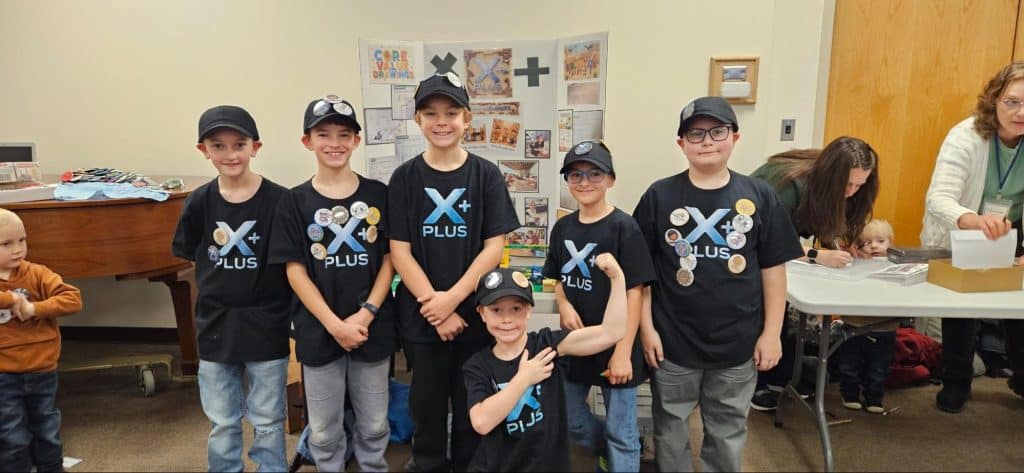
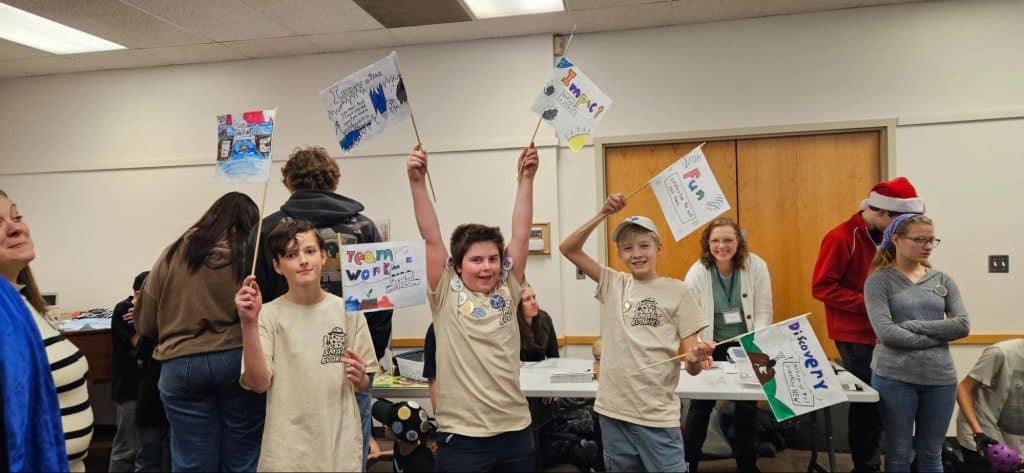
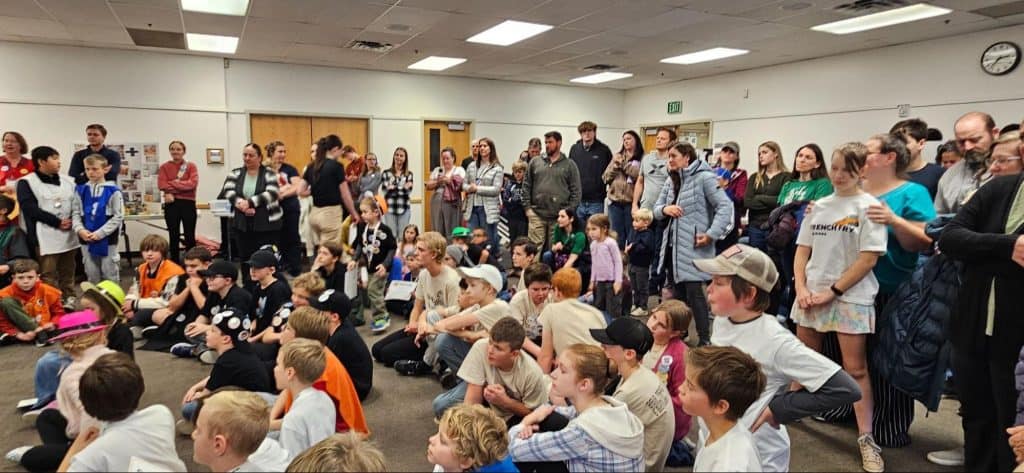
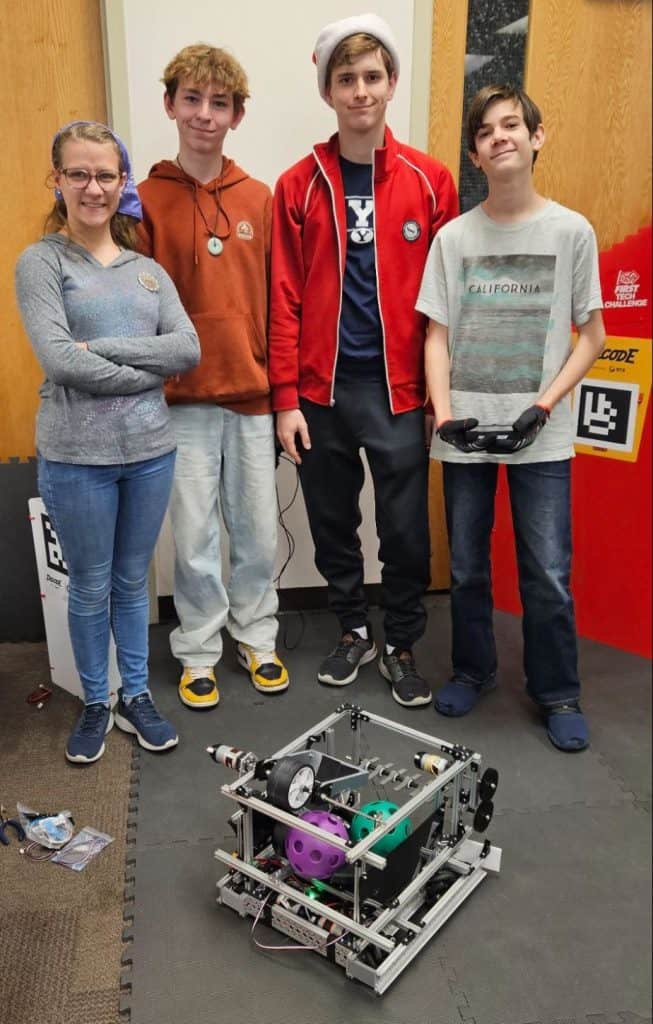
The Robotics classes held a Robotics Showcase on Friday, December 5th at the Sandy Library. It was an incredible event where each team showed the projects they’ve been working on and their robots.
All the Robotics teams participated in the event.
This was the culminating event for the Explore teams (ages 7-10). Awards were given to each Explore team. Congratulations to all of them for all the work they put in this semester!
- Core Values Award – Peach Gangsters – Chloe Smith, Levi Riffle, River Smith, Violet Smith, Noah Manley
- Engineering in Excellence Award – X+ – Greyson Duffin, Liam Krueger, Finley Harris, Jack Welch, Zach Darrington, Lochlan Cahoon
- Fun with LEGO Award – Robot Animals – Zoe Riffle, Andy Sproul, Sam Beirdneau, Eliza Sanders, Roman Sanders
- Presentation and Communication Award – Eagles – Nate Graden, Hunter Conrad, Edison Bischke, Grayson Bischke, Finn Morkel
Challenge teams (ages 10-13) from Mapleton, Saratoga Springs, and Woods Cross and the FTC team (ages 14+) from Highland shared their projects, robots, and the things they’ve been working on. The Challenge teams and the FTC team will be competing in qualifiers starting in January. Check out all the fun in Robotics Showcase Photos.
November Weber State Speech and Debate Tournament
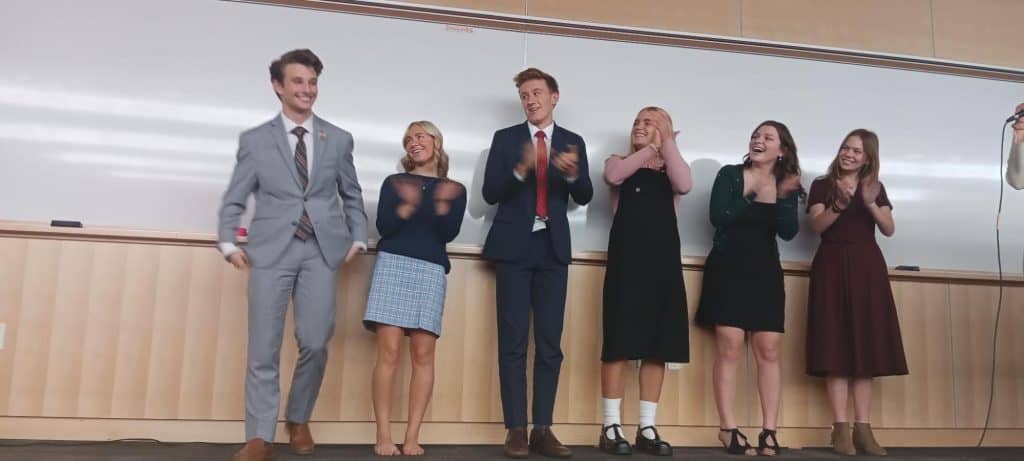
The November Speech and Debate Tournament was held at Weber State on Saturday, November 15. Thank you to Weber State for hosting it! There were 300+ competitors and almost 80 judges! Congratulations to all of the competitors! You can see Tournament Pictures Here and Results Here.
1st Amendment Speech Winners
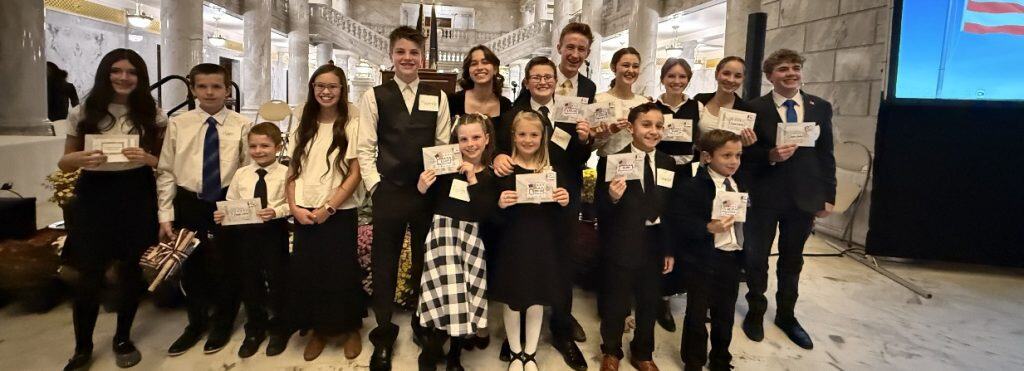
The Finals for the 1st Amendment Speech Contest were held Friday, November 7, at the Utah State Capitol Rotunda. The event consisted of speeches paying tribute to victims of communism. There were many IEProgram students (and their siblings!) who were selected to speak at the culminating event. It was an amazing event! Congratulations to all of them! Below are the winners who have IEProgram ties.
Grades 1-4
1st Place – Faith Moore: Freedom of Religion, Richard Wurmbrand, Romania
Grades 5-8
4th Place – Auri Walker: Freedom of Speech, Doina Cornea, Romania
5th Place – Maverick Moore: Freedom of Press, Paul Goma, Romania
Grades 9-12
1st Place – Joy Moore: Freedom of Assembly, People of Tuisuara, Pastor Tolkis December 1989, Romania
2nd Place – Heber Tanner: Freedom of Speech, Sergeant James Johnson, USA
3rd Place – Katie Bell: Freedom of Speech, Eduard George Atomei, Romania
4th Place – Sophie Shields: Freedom of Speech, Nikolai Gumilev, Russian Poet and Soldier
Adult Seminars

Arguing for America Seminar
Mary Stoddard, the Director of the Constitution Studies program, presented two sessions of her presentation Arguing for America in November. The information was important, pertinent and valuable for those who attended. After the seminars, Mary was invited to present at an Ethics Symposium at UVU!
Get access to the seminar video by filling out the form linked below.
Seminars will continue in January and February. ToriAnn Perkey will be presenting on two topics. Save the dates and watch for registration in January.
- January 29 at 6:30 on Homeschool to College
- February 26 at 6:30 on You, Your Kids, and AI: Safety & Skills for the New Digital Frontier
Robotics Fundraising and Sponsorship

Thank you to everyone who participated in the Robotics Swig fundraiser! It was a big success and the Robotics teams are grateful for everyone who bought gift cards. The Robotics Program is always looking for sponsors and mentors. If you are interested in learning more about how you can contribute or get involved with the Robotics program, visit their website here: https://www.ieprobotics.com and click on Get Involved.
Looking for Teachers
It’s time to start planning for the 2026-2027 school year. We’re looking for teachers to teach next year in the IEProgram. If you’re interested in applying, apply here 2026-2027 Teacher Application.
We are especially looking for the teachers for the following:
- Robotics
- Pre-algebra
- English in Utah County
Alumni Spotlight: Anabel Jackson

Anabel’s last year in Speech and Debate was in 2020. She is currently studying at Weber State University to be a teacher. She served a mission for The Church of Jesus Christ of Latter-day Saints in Las Vegas, Spanish speaking and in the Layton Utah mission in various capacities.
Anabel said, “I can thank Sam (and Speech and Debate) for so many skills he helped me gain through practice and feedback. From his classes, I learned how to own responsibility for my actions, how more practice correlates with improvement and confidence, how vital feedback is to improvement, how to celebrate the successes of others, how to lead, and how to do great things. He taught me through his actions that he truly cared about my progress, effort, and development. He showed his disappointment when I chose not to do what he knew I could, and he celebrated my successes, improvements, and my unique personality. He really does care about the one. I would not have done as well in college without all that he taught me, and how he helped me become who I am today.”
Alumni! We’d love to spotlight you! We want to know what you’re doing, celebrate your accomplishments, or hear how IEProgram classes have helped you as you’ve moved forward in life! Please let us know what you are doing here: Alumni Corner Submissions We’ll share your contributions in future newsletters.
Insights in Education: Fake Choices

By Sam Martineau
General Director
I think of a particular experience frequently when I come in contact with the concept of “youth leadership.” I was in a meeting for a young men’s group and the only agenda item was planning out a summer campout that would be happening in about six months. As is often the case, the adult leadership began the meeting by saying something like, “All right, remember that this is your campout not ours, so that’s why you are here, to plan your campout.” First item to take care of, the adults said, was where to go camping. “So where do you want to go camping?” Several of the boys had a ready answer. They wanted to go to southern Utah. They had been to southern Utah the year before and had a great time and they wanted to go back.
The adults seemed less than enthused (and also prepared for this potential response). “Don’t you think that southern Utah would be a little hot? I mean we are planning on going in July, so don’t you think that it will be very hot in southern Utah in July?” The boys seemed uncomfortable. They obviously didn’t think it would be too hot, or else they wouldn’t have made the suggestion. But, unsure how much they were allowed to push back on this issue, there was some resistance which then gave way as the adults in the room piled up objections to the youths’ preferred location.
“You know what’s a lot like southern Utah but is a lot cooler? Flaming Gorge is a lot like southern Utah, but it’s further north and it has a lot of water you can play in to stay cool. Doesn’t Flaming Gorge sound good?”
The boys nodded their heads. “Ok. Flaming Gorge. Is everyone ok with that? Is that everyone’s choice?” Clearly not, but the boys nodded their heads. “Ok, we have that settled. Let’s talk about the meals we’re going to have.” I was not shocked when the boys contributed little to the rest of the discussion. And I was also not shocked when the adults left the meeting frustrated that the boys wouldn’t engage and take more ownership.
I think about this experience as a sort of archetype of the problems that seem to plague youth leadership. I say it is an archetype, because I would bet that everyone reading this article, youth or adult, who has been part of an experiment in youth leadership has sat through a similar meeting. Adults are leading the discussion trying to get youth to make decisions. Youth sit shrugging shoulders and nodding heads. There is lots of uncomfortable dead space. And no one really seems satisfied with the experience.
And yet, even though this or similar scenes play out over and over and over again, adults just can’t seem to give up on or change the concept of “youth leadership.” We can’t help ourselves. We want our children and our students to be leaders. We have this vision of how incredible it could be if they were mini adults instead of youths. We think it will be so good for them! We just can’t give up the dream.
And yet, we also have a sneaking suspicion and fear that if we’re not in charge, it will turn out that they aren’t mini adults, and we know that even adults fail plenty enough anyway, so we can’t really give up the reins. So we end up in this sort of unfortunate middle ground in which youth aren’t really in charge, adults aren’t really in charge, and no one is really in charge, so the adults end up making all the decisions anyway, except usually at the last minute because the youth just wouldn’t “engage” and “take ownership”.
I hope I’m not coming off as critical or cynical. I feel strongly about this issue, but I hope to express that I applaud anyone who engages in the difficult work of preparing the coming generation for life in any context. I appreciate their efforts and recognize that all of us have our strengths and shortcomings. I also believe that, done well and in the right context, youth leadership has great potential. So I’ll offer some concepts on youth leadership that I hope will be helpful in keeping adults in the education space out of that aforementioned unfortunate middle ground.
Concept #1: Remember Why Adults are in Charge
Adults and children are different in concrete ways. Adults have more life experience. They have more knowledge. They understand the information, intricacies, and contexts of the subjects they teach better. They have a broader and more mature concept of what really matters in education, in social situations, and in life. Adults are less impulsive and they are better at planning and following through. They are less egocentric, less insecure, better at taking good risks, and also better at not taking bad risks.
To be clear, this is not because children are stupid or morally bankrupt. The teen years are a necessary ticket in brain development that absolutely must be paid in order to arrive at adulthood. Also, there is plenty of variation on these issues among children and among adults. But these statements are still broadly true. So if one were to choose who should plan out and execute a curriculum or an experience for children, then overwhelmingly adults are the better choice.
That doesn’t mean that it is always the choice you want to make. You may choose to have youth do the planning because you think it will be a growing experience for the ones planning or because you believe that youth will be more invested if they are in charge. You might also have youth plan and execute activities because they may have a sense of what is relevant among their peers. But if the goal is to make an experience better for the youth participating, then in a general sense, the clear choice is adults.
There is a simple reason why I and not my students write the curriculum for my classes, choose the structure for debate tournaments, pick the activities that will take place in my class day by day, etc.. It’s the same reason that I’m the teacher of the class and my students aren’t.
Again, this doesn’t mean I’m against the concept of youth leadership all together. We have a very active Student Council for the IEProgram and they do a great job. There are contexts and reasons for which youth leadership makes a lot of sense. But when approaching the concept of youth leadership, it is worth remembering that choosing for adults to simply be in charge and to create a great experience for youth is an entirely acceptable and often the best approach.
So, in the case of the summer camp above, getting youth involved in the planning was an acceptable option. It also would have been an entirely acceptable option for the adult leadership to choose location, agenda, meals, explain what was going to be great about the experience, ask who was attending, and hand out assignments to be completed to youth. And between that option and the unfortunate middle ground that actually ended up playing out, adult leadership would likely have been the better choice.
The Takeaway: Youth leadership doesn’t need to be forced where it isn’t working or it doesn’t make sense.
Concept #2: Don’t Give Fake Choices
But let’s say that you’ve decided that you want youth to lead in a given context. The first and most critical issue is to get very clear about which choices will belong to you and which choices will belong to them. Otherwise you’ll end up offering fake choices to children and nothing will kill an experience in youth leadership faster than this.
In the example above, the boys were told that they had a choice. They had initial excitement over the ability to make that choice because they had real preferences for that choice. But all of that excitement evaporated immediately when it became clear that they, in fact, did not actually get to make that choice. So can you blame them for disengaging for the rest of the experience? Have you ever enjoyed playing the game “Guess what I want you to choose?” I certainly haven’t. I didn’t enjoy it when I was a teenager, and neither has a single teenager that I’ve spoken to about the issue either.
I’ve actually spoken to many youth about that specific game over the years. They’ve all played the game and, not shockingly, none of them like it. To them, the entire experience feels fake, like a sad sort of theater with a script they are supposed to guess so that adults can feel like youth are in charge without actually giving up control.
So, if you don’t want youth to disengage immediately, then it’s time to get clear. Do they get choices or don’t they? If you’re not ok with youth making a choice, then the answer is simple. Don’t give them the option. And if you are, then be willing to live with the consequences.
So let’s imagine other things that might have been said to these boys, and I’ll invite you to think about how these sort of statements might have changed the contours of the meeting I’ve described.
“Okay, we have three spots that we are willing to consider as options. We think they all have pros and cons. We’ll tell you what we see as the pros and cons of each, we’ll answer your questions, and then you can choose whichever you like and we’ll help you make that happen.”
“We have decided that we are going to go camping at Flaming Gorge. We’ll tell you the reasons why, but we also have portions of the trip that we want you to be in charge of, so we’ll lay those out and we’re excited to see the decisions you make.”
“You can choose any location that is within a four hour drive. It has to be camping, and it has to fit inside of our budget. Anything that fits in those criteria, we will accept.”
“Okay, we can see that you really like southern Utah. We have concerns about the heat and our current plan is to go in July. So here is what we are willing to do. If we can find a week that works for everyone before June 15th, then we’ll do what you want. Otherwise, we’ll have to find a different location.”
Now, for reasons you’ll read below, I actually wouldn’t take any of these approaches either if I wanted youth to be in charge of campout. But because they give real choices to youth, they would constitute a major upgrade from the norm in youth leadership.
The Takeaway: Decide and communicate clearly which choices youth will make and which they will not.
Concept #3: Allow Meaningful Choices
So giving youth real choices is essential to youth leadership. But in addition to those choices being real, they must also be meaningful.
Sometimes, when my very young children don’t want to do something, I’ll throw them a meaningless choice so that they have a sense of control. It’s a cheap parenting trick and mostly doesn’t work. You say to your four year old who doesn’t want to get dressed “Do you want to wear the pink shirt or the yellow shirt?” They don’t want either. Even four year olds can see through it. And if four year olds can see through it, what are the chances that a fourteen year old doesn’t?
“Remember that this is your campout not ours, so that’s why you are here, to plan your campout.” The statement was manifestly untrue, because it turned out that the only decisions that the leaders were truly willing to offer the youth were about minor details. So what kind of leadership is that?
If leadership is going to be compelling and meaningful for youth, then there have to be real stakes and real responsibility and they’ll need a sense of accomplishment by the end. And how accomplished or responsible does one feel for choosing that breakfast is going to consist of eggs and bacon? The answer, my friend, is not very. Not very at all.
In order for there to be a sense of satisfaction at the end of a journey, there had to be a chance that the journey would be a failure. It’s a pretty amazing thing when a youth can look at themselves and say, “I made that happen” with a sense of pride. But if that is going to happen, then the word “that” in the sentence has to mean something.
So I suggest a choice. For a given project, either decide that youth are going to have real choices and real responsibility with real consequences and a real chance of failure, or just don’t give them leadership.
The Takeaway: Only meaningful responsibilities fulfill the purposes of youth leadership.
Concept #4: Why Are Adults In Front… Or Even Present?
In concept one I said that I liked the approach of telling the boys which choices they could and couldn’t make for location better, but ultimately wouldn’t choose that approach. This isn’t because I don’t like the clear outlining of which choices belong to youth and which belong to adults. Rather, I question the entire structure of exercise. If the campout belongs to the youth, then why are the adults running the meeting? Why are they even in the room? The answer is, of course, that this isn’t the youths’ campout. It is the adults’ campout that they are providing for the youth and they aren’t actually ok with the youth being in charge because they are unwilling to see an unsuccessful campout. So they have to be in the room to make sure that the discussion succeeds in the ways they would define success.
But let’s enter an alternate universe where the adults are willing for the campout to be a failure. They are ok if it never happens. They are ok if it is really rocky. If it happens, then it will have to be safe and meet some basic standards, but outside of that, they have decided that they are ok with however it goes down. Now ask the question, why are the adults leading the discussion? Why are the adults even present?
In the case of my Student Council, which has a years-long track record of very successful youth leadership, I choose students who I believe are ready for leadership. I don’t put anyone on the Student Council who I don’t think will succeed on the Student Council. I express to them my expectations including basic requirements for what they should accomplish, principles for how they should operate, and how often they should meet. I give them a leadership structure including who is in charge of what. I help them understand the sort of resources and support they rely on. I communicate which sorts of decisions they are allowed to make and which they are not. And then, most importantly, no adult is ever allowed in their meetings. I have never attended a single Student Council Meeting. By my requirement, no one on my staff does either. This year Mattox Botkin, our Student Council President, calls and runs the meetings. He also planned and executed a Student Council “retreat” at which neither myself nor anyone on my staff was present. Do all the meetings get called? Probably, but I’m not certain. Are they well run? I believe in Mattox, so probably not perfectly but I would bet reasonably well.
Imagine being a student in that environment. You have real choices. You can accomplish big things or little things or nothing. You’ve gotten together, and now it’s all on you. What do you do?
I’ll tell you what you do: you sink or swim. Mostly you swim. I’ve seen my student council produce yearbooks, put on dances, make a podcast, put together giant games, run activities at tournaments, offer support to younger students, and many other meaningful projects. Some years they do more. Some years they do less. They always accomplish some big things. They never accomplish everything they want to. But the key is that whatever they do accomplish is truly theirs. They can, in fact, say, “We accomplished this.” because I can’t take ownership. I literally wasn’t there!
My experience says that if adults are in the room, then youth will never be able to say, “We accomplished this.” because if adults are in the room, then anything else might be claimed, but the fact is that the adults are in charge.
This isn’t to say that our Student Council has no accountability. Our Mattox has to periodically report on what projects are being taken on. Projects have to receive approval. We reserve the right to express concerns and send projects back to be reworked. But in the actual nuts and bolts, youth are leading in reality, not as part of a sad theater.
It is incredible what youth can accomplish when they are ready for leadership and they are given real leadership.
The Takeaway: If you want youth to lead, then take away their (and your) safety net by just not being in the room.
Concept #5: A Different Kind of Support
I hope you’ve caught a vision for youth leadership that can help break out of the unfortunate middle ground where no one is in charge. In this alternate vision there are definite things that adults are in charge of and definite things that youth are in charge of. If the stakes are high enough that failure is unacceptable, then adults are in charge for real and they don’t pretend that the youth are in charge. If the stakes matter but failure is acceptable, then youth can be in charge for real.
In this vision support looks different. Usually, support in youth leadership looks like adults guiding youth through making decisions, holding their hands to make sure that they don’t make the wrong ones, and trying to inspire them to engage. But if youth have real ownership and real responsibility then support has to look quite a bit different.
What support means in this context is training, structure, and guidelines. You offer them the training that you believe that they will need in order to succeed, structure so that they know how to operate, and guidelines for what they are allowed to do and what they are not allowed to do.
Let’s go back to our campout meeting to see what that might look like. Imagining, again, a world where adults are ok if the campout flops or maybe doesn’t even happen, and they have youth who are capable of planning and executing a campout to a reasonable degree, then training support and guidelines might look like-
- Assigning one youth to be in charge of organizing and making final decisions.
- Facilitating a discussion asking youth what they want out of the campout experience and explaining what you would hope to see come out of the campout experience.
- An explanation of what support the youth can rely on such as, “We’ll take care of transport to and from the location” or “We’re happy to prepare and run specific activities if you’ll give us enough time to prepare.”
- Explaining to youth what the budget is for the campout and what minimum safety requirements must be met.
- Explaining deadlines for when you will need information such as a location, a meal plan, a trip itinerary, etc.
- Explaining elements that must be part of the plan such as, “We want you to include at least one physically challenging activity each day.”
- Explaining how many times you think they’ll need to meet in order to come up with a successful plan.
- Expressing confidence that youth can and will pull off a great campout and an assurance that they can reach out if their progress stalls.
From personal experience, I can observe that youth are able to create incredible things out of this type of training and support. Not every youth is ready for that level of responsibility, and every context is different enough that different approaches are merited, but when solid training, structure, and guidelines replace handholding and games of “guess what the adult is thinking” great things can happen.
The Takeaway– Great training and support set kids up for successful youth leadership.
Conclusion
As I’ve said, I appreciate every person who puts forward effort into youth. They need us, and everyone putting forth sincere efforts deserves to be praised. And I also don’t imagine that the IEProgram is the only place where youth leadership is flourishing. Nor do I see my thoughts here as comprehensive or definitive. I’ve seen a number of outside examples of youth accomplishing great things with adult guidance and support and everyone does it a little differently. But to be frank, I think that we can often do better for our youth in the youth leadership department. To that end I hope that all will find this article a meaningful contribution to their thoughts on how to carry that out.
P.S. Christmas is personally always a time when I reflect on the great blessings I have in life. As we approach that time I would simply like to express my profound gratitude for the opportunity to live and work in this community. The opportunity to teach my students, get to know the students taught by other teachers, rub shoulders with parents, and work with our most wonderful teachers, staff, Teacher’s Assistants, and Student Council constitutes one of the great blessings of life for me. My life is better because I get to know you. “For the joy of human love” as the song says, I offer my deepest gratitude.